Why Every Trade Needs Confirmation: How to Stop Chasing and Start Seeing the Signal

Signals, Trading
You've spotted a great-looking setup. Price is sitting at a level that looks perfect. Your gut says go.
So you enter.
And then… price does the exact opposite.
Sound familiar?
Here's the thing — you didn't have a bad setup. You just jumped in before the market confirmed it. And in crypto trading, that difference can cost you real money.
This article is going to show you exactly what signal confirmation looks like, why it matters for every trade, and how to use two simple concepts — BOS and CHoCH — to stop guessing and start reading the market with real clarity.
By the end, you'll understand why professional traders don't just look for a "good area on the chart." They wait for the market to prove it.
What Is Signal Confirmation (And Why Should You Care)?
Signal confirmation is simply the process of waiting for the market to give you a clear sign that a trade is valid before you put your money in.
Think of it like crossing the road. You don't just step out because you think no cars are coming. You look both ways. You wait for the signal. You confirm it's safe.
Trading works the same way.
An area on your chart that "looks interesting" is not a trade. It's a location where something might happen. The confirmation is what tells you the market is actually ready to move — and in which direction.
Without confirmation, you're essentially guessing. With it, you're making a logic-based decision grounded in what price is actually doing.
Here's the core truth most beginners miss: an area of interest only becomes a trade when the market proves it. Until then, it's just a line on your chart.
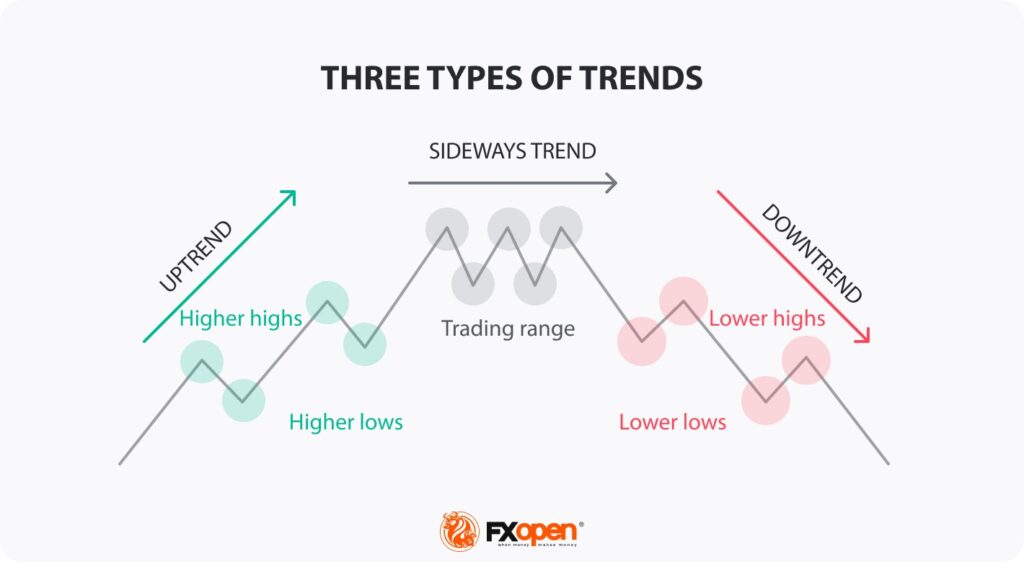
An Illustration showing the different Market Trends. Image Source: FXopen
The Building Blocks: What Is Market Structure?
Before we dive into confirmation signals, you need to understand the foundation they sit on — market structure.
Market structure is simply how price moves. And price always does one of three things:
It trends upward (makes higher highs and higher lows — buyers in control). It trends downward (makes lower highs and lower lows — sellers in control). It moves sideways (no clear direction — the market is undecided).
That's it. Every chart you'll ever look at fits into one of those three states.
Now, here's why this matters for your trades: big players — institutions, banks, smart money — don't buy and sell randomly. They leave footprints in market structure. And those footprints are what we use to confirm a trade.
Think of it like watching someone walk through fresh snow. You can't see them, but you can follow their tracks. Market structure is those tracks.
When you learn to read structure, you stop reacting to random candles and start seeing the bigger story the market is telling.
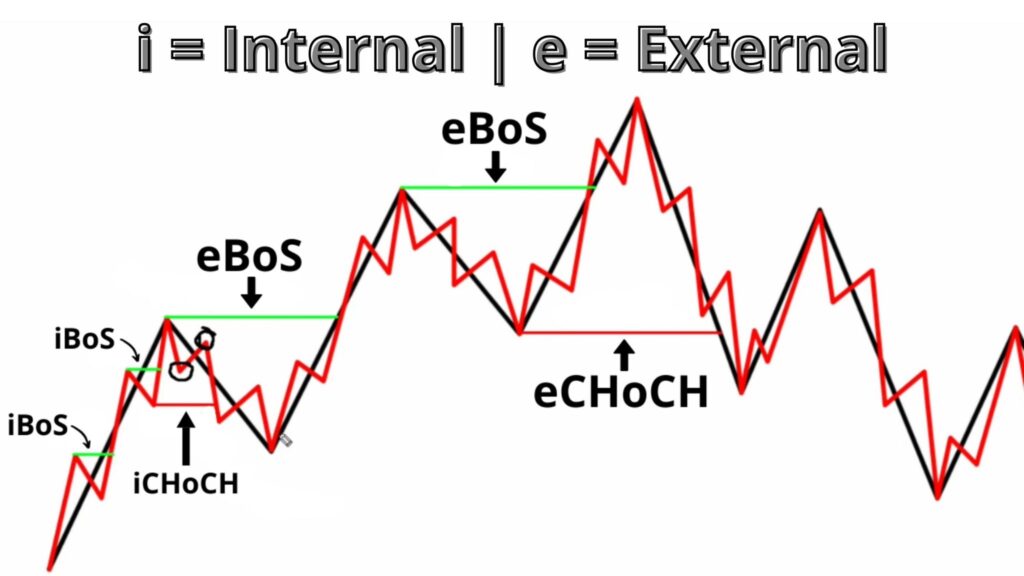
An Illustration showing the Break of Structure (BOS). Image Source: MindMathMoney
BOS: Your Signal That the Trend Is Continuing
The first confirmation tool you need to know is the Break of Structure (BOS) — pronounced exactly as it sounds.
A BOS is your strongest signal that a trend is healthy and continuing.
Here's how it works in plain language:
In an uptrend, the market is creating higher highs and higher lows. A BOS happens when price breaks above the most recent high. That's the market saying: "Yes, buyers are still in control. The trend is still on."
In a downtrend, price is creating lower lows and lower highs. A BOS happens when price breaks below the most recent low. That's the market saying: "Sellers are still running this. Keep going."
Let's say Bitcoin has been trending up and you're looking for a buy opportunity. After a pullback, Bitcoin pushes higher and breaks above the last swing high. That's a bullish BOS. The uptrend is confirmed. Buyers just showed their hand.
Important detail: For a BOS to count, you need a full candle body to close beyond that level — not just a wick poking through. Wicks are noise. Full-bodied closes are intent.
💡 Pro Tip: BOS doesn't tell you exactly where to enter — it tells you which direction to look for entries. After a bullish BOS, you'd look to buy on the next pullback. After a bearish BOS, you'd look to sell on a bounce.
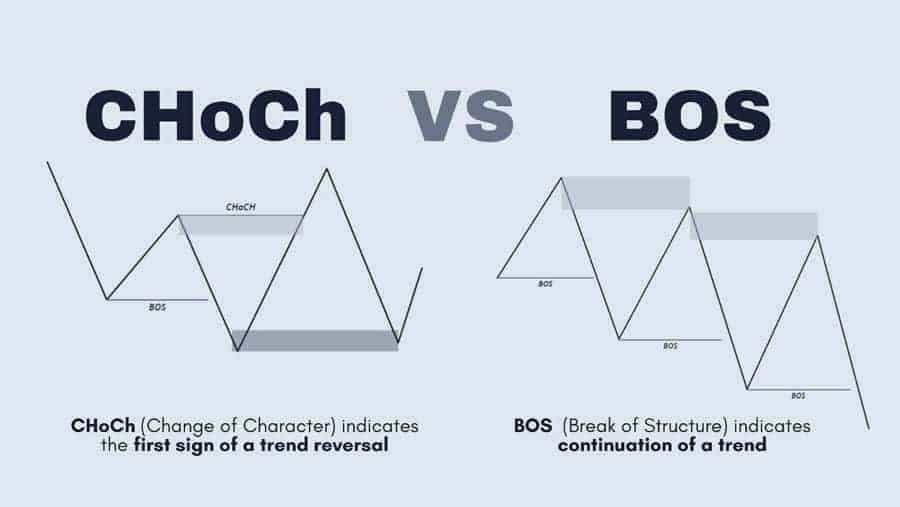
An Illustration showing the difference between CHoCh and BOS. Image Source: Opo Finance
CHoCH: The Early Warning Sign a Trend Might Be Ending
Now here's where it gets interesting — and where most beginners lose money.
CHoCH stands for Change of Character (sometimes written as CHoCH or CHoCH). It's the market's first honest signal that a trend might be losing strength and a reversal could be forming.
Think of a BOS as the train staying on its current track. A CHoCH is the train switching tracks — it doesn't guarantee the train is going in a completely new direction, but it tells you something has changed.
Here's how to spot it:
In an uptrend (price making higher highs and higher lows), a bearish CHoCH happens when price breaks below the last higher low. That's the first time buyers have failed to hold that level. The uptrend structure just cracked.
In a downtrend (lower lows and lower highs), a bullish CHoCH happens when price breaks above the last lower high. Sellers couldn't hold it down. Something has shifted.
Let's make this real. Imagine Ethereum has been in a downtrend for weeks. Then, suddenly, price pushes up and breaks above the last lower high — something that hasn't happened through the entire move. That's a bullish CHoCH. You can't call it a new uptrend yet, but you should absolutely stop looking for shorts and start watching for bullish setups.
⚠️ Common Mistake: Many beginners see a CHoCH and immediately jump into a trade, thinking the reversal is guaranteed. It's not. A CHoCH is an early warning, not a confirmation. The confirmation comes when price forms a new structure in the opposite direction and then a BOS follows. Patience here saves accounts.
Putting It Together: The Confirmation Process Step by Step
Now let's look at how BOS and CHoCH work together in a real confirmation approach.
Here's the sequence professional traders use:
1. Identify the current trend. Is the market making higher highs and higher lows (uptrend) or lower lows and lower highs (downtrend)? This is your first step, always. Without knowing the trend, you're flying blind.
2. Wait for a CHoCH to signal a potential shift. If you're watching for a reversal, the CHoCH is your early alert. It doesn't mean trade now. It means pay attention.
3. Watch for a BOS in the new direction. After a CHoCH, you want to see price start making structure in the opposite direction and then break that structure. This is your confirmation.
4. Look for a pullback to enter with reduced risk. Experienced traders don't buy the BOS itself. They wait for price to pull back and then enter at a better price with a logical stop loss.
5. Define your stop loss and target before entering. Your stop loss goes below the last swing low (for longs) or above the last swing high (for shorts). Your target is the next major structural level.
Let's walk through a quick example. Say Bitcoin has been falling hard. You spot a bullish CHoCH — price breaks above a lower high for the first time. You stay patient. Over the next few hours, price starts making higher lows. Then it breaks above a swing high. That's your BOS. That's your confirmation. Now you look for a pullback to enter.
No guessing. Just structure.
Multi-Timeframe Check: One Simple Habit That Improves Your Win Rate
Here's a habit that can dramatically improve the quality of your trades: always check a higher timeframe before executing on a lower one.
This is called multi-timeframe analysis, and it's simpler than it sounds.
If you're looking for trades on a 15-minute chart, check the 1-hour chart first. If the 1-hour chart shows a strong downtrend, don't go looking for buys on the 15-minute. You'd be fighting the bigger picture.
But if the 1-hour is bullish and you spot a bullish CHoCH and BOS on the 15-minute — that's alignment. That's a high-quality setup.
Think of it like swimming in the ocean. You can paddle forward (your lower timeframe signal), but if the current is against you (your higher timeframe trend), you're going to struggle. Trade with the current, not against it.
Quick Recap
Here's what you've learned:
- Signal confirmation means waiting for the market to prove a trade is valid before risking capital — not just finding a nice area on the chart
- Market structure is the pattern of highs and lows that tells you who's in control — buyers, sellers, or neither
- BOS (Break of Structure) confirms a trend is continuing — a full candle close beyond a previous high or low in the direction of the trend
- CHoCH (Change of Character) is an early warning that a trend may be shifting — wait for a BOS in the new direction before trading
- Multi-timeframe alignment dramatically improves trade quality — higher timeframe bias first, lower timeframe execution second
- Wait for the pullback after a BOS for a lower-risk entry rather than chasing the initial move
Your Next Steps
Signal confirmation is a skill you build through practice and patience. Here's how to start right now:
1. This week: Pull up three crypto charts and practise identifying market structure only. Label every swing high and swing low you see. Don't trade yet — just observe. You're training your eyes to read the language of price.
2. Next week: Using those same charts, look for past examples of BOS and CHoCH. Can you find moments where the trend continued (BOS) or shifted (CHoCH)? This historical practice will build your pattern recognition faster than anything else.
3. Ongoing: Before every trade, run through the checklist: What's the higher timeframe trend? Has there been a CHoCH? Is there a BOS confirming direction? Is there a pullback to enter on? If you can't check those boxes, don't trade.
Remember — the best traders aren't the ones who trade the most. They're the ones who wait for real confirmation and act decisively when the market shows its hand.
You're building a genuine skill here. Every time you skip a bad trade because it didn't have confirmation, that's a win just as real as a profitable one.
Join the Fat Pig Signals Telegram community where we discuss setups like these in real time, share confirmation signals, and help each other navigate the market together.
[Join our Telegram group here] and start learning with a community that takes trading seriously.
You've got this. Keep learning, stay patient, and let the market show you the signal before you act.
Disclaimer: This article is for educational purposes only and should not be considered financial advice. Cryptocurrency trading involves substantial risk of loss. Always do your own research and consider consulting with a financial advisor before making investment decisions.
Related Articles

Crypto Signals: What You Must Know to Start as a Trader

7 Reasons Why You Lose Money In Crypto Trading