Are Crypto Signals Worth It? Real Results and Common Mistakes (2026)
Signals
You've probably seen the screenshots.
Massive green candles. "10x in 48 hours." A Telegram group with 80,000 members promising they can turn your $500 into life-changing money.
So you ask the obvious question: Are crypto signals actually worth it? Or is this all just hype?
It's a fair question — and one that deserves a straight answer.
The truth is: crypto signals can be worth it. But most beginners use them completely wrong, join the wrong groups, and end up more confused (and poorer) than when they started.
By the end of this article, you'll know exactly how to tell a real signal service from a scam, what realistic results look like, and the five mistakes that kill most beginners before they even get started.
What Does "Worth It" Actually Mean?
Before we answer whether signals are worth it, we need to be clear on what "worth it" means.
If you're expecting crypto signals to make you rich automatically — signals are not worth it. Nothing works that way, and any service promising guaranteed profits is lying to you.
But if "worth it" means saving you hours of research, giving you structured trade ideas with clear risk management, and helping you learn how experienced traders think — then yes, a quality signal service absolutely delivers that.
Here's the honest framework:
- Signals are a tool, not a magic button
- They give you trade ideas — you still have to execute properly
- The quality of results depends almost entirely on which service you choose and how you use it
Think of it like a GPS. A GPS gives you directions — but if you're driving recklessly, ignore the route, or follow a broken map, it won't save you from crashing.
What Real Results From Crypto Signals Look Like
Let's talk numbers — because this is where most people get misled.
What scam groups claim: "97% win rate." "10x every week." "Never a losing trade."
What reality looks like: Even the best professional traders in the world win around 55–65% of their trades. That's it. Not 90%. Not 97%. Around six in ten.
So how do profitable traders make money if they lose 35–45% of the time?
The answer is risk management — specifically, making sure your winning trades earn more than your losing trades cost you.
Here's a simple example:
You make 10 trades. 6 win, gaining +3% each = +18% total 4 lose, losing -1.5% each = -6% total Net result: +12% profit
That's a 60% win rate with modest gains per trade — and it's genuinely profitable. You don't need to win every trade. You need your wins to outweigh your losses.
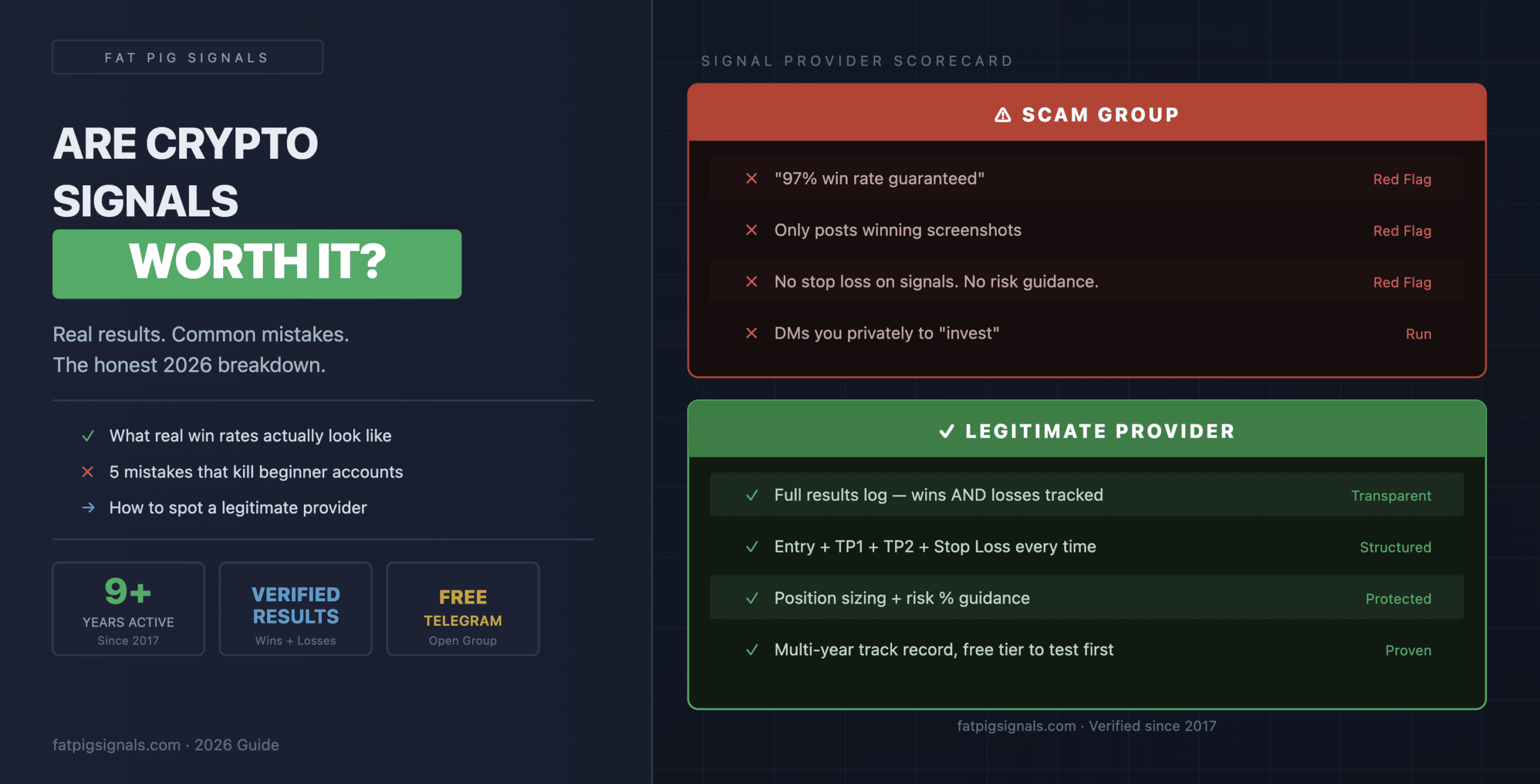
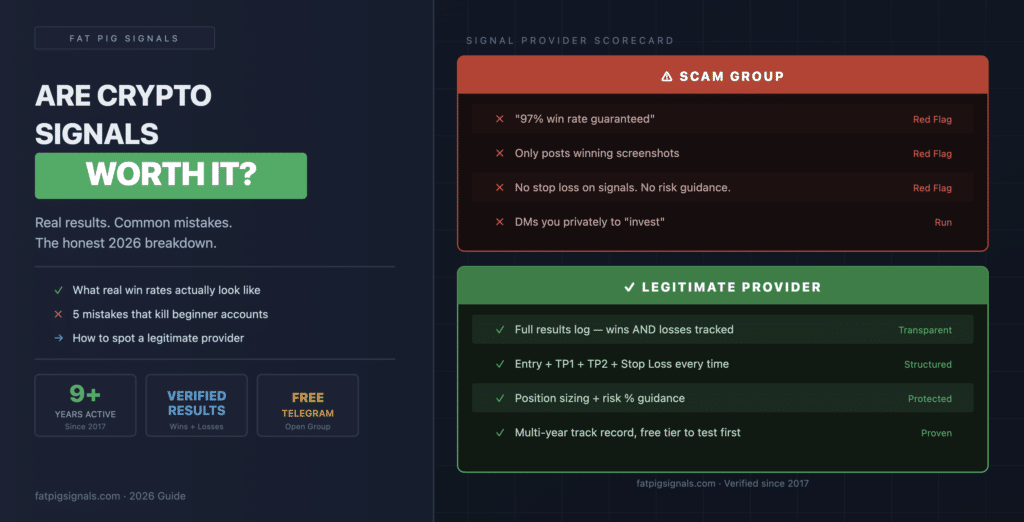
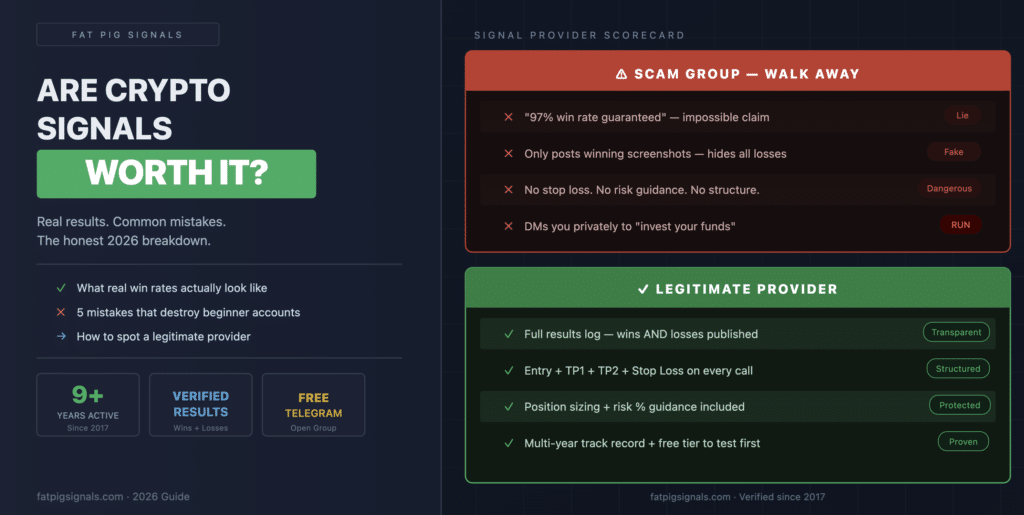
A legitimate signal provider shows you both sides of this. They publish wins and losses. They track results over months and years, not just cherrypicked screenshots from one good week.
Pro Tip: Before joining any signal group, ask: "Can I see your full results for the last 6 months, including losing trades?" If they can't answer that — or only show wins — walk away.
The 5 Mistakes That Make Crypto Signals "Not Worth It"
Here's the truth most people won't tell you: the reason signals "don't work" for most beginners has almost nothing to do with the signals themselves.
It's almost always one of these five mistakes.
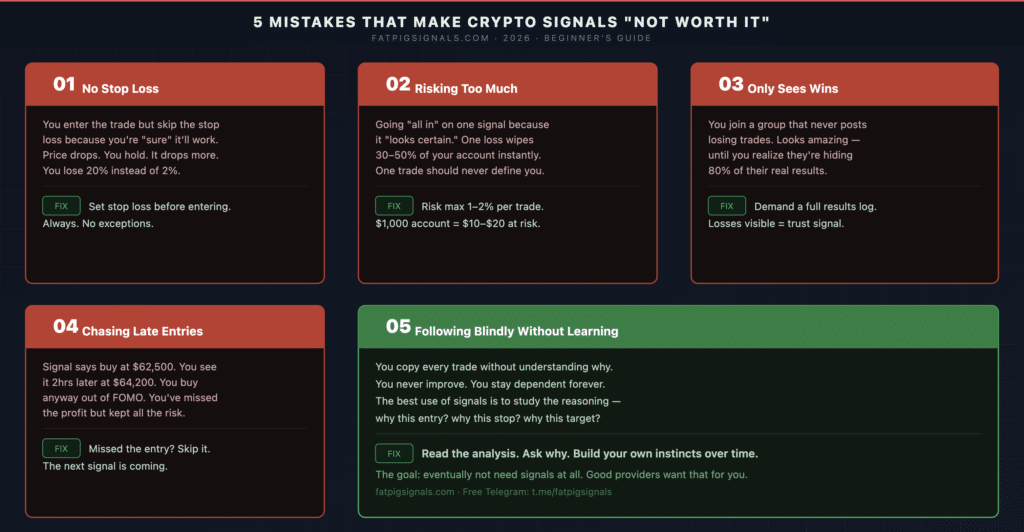
Mistake 1: Following Signals Without a Stop Loss
A stop loss is an automatic exit order — it closes your trade if the price drops to a certain level, limiting how much you can lose.
Every legitimate signal includes one. It looks like this:
ENTRY: $62,500 TP1: $64,000 TP2: $67,500 STOP LOSS: $60,800
The stop loss is the most important number on that list. It's the line that protects your account if the trade goes wrong.
Beginners often skip it. They buy the entry — but don't set the stop loss because they're "sure" the trade will work. Then the price drops, they panic, they hold, it drops further, and they lose 20% instead of the 2% the stop loss would have limited them to.
Rule: Never enter a signal without immediately setting the stop loss. No exceptions.
Mistake 2: Risking Too Much Per Trade
This is the fastest way to blow up your account.
The professional standard is to risk 1–2% of your total account per trade. That means if you have $1,000, you risk $10–$20 per trade — not $100, not $500.
Most beginners ignore this completely. They go "all in" on one signal because it looks like a sure thing. One loss later, they've lost 30% of their account on a single trade.
Even if a signal provider has a 70% win rate, you can still destroy your account by betting too big on the 30% of trades that lose.
Boring but true: position sizing saves accounts. Greed destroys them.
Common Mistake: Going all-in on a "high confidence" signal. There is no such thing as a guaranteed trade. Size every position as if it could lose — because it can.
Mistake 3: Joining Groups That Never Show Losses
If a Telegram signal group has 50,000 members and only posts screenshots of winning trades — they're either lying, or they're posting so many signals that some randomly hit and they ignore the rest.
Real providers track everything. A pinned results post. A Google Sheet. Monthly summaries that include losses.
Transparency about losses is the single clearest sign of a legitimate service. It takes confidence to post a losing trade. Scammers never do it.
Mistake 4: Chasing Late Entries
A signal says: "BUY BTC at $62,500."
You see it two hours later. Bitcoin is now at $64,200.
The mistake: you buy anyway because you don't want to miss out.
This is called FOMO (Fear of Missing Out), and it's one of the most expensive habits in trading.
When you buy late, you've already missed most of the potential profit — but you've inherited all of the risk. The trade was designed around a specific entry price. That price had a specific risk-to-reward ratio. If you enter higher, the maths no longer work in your favour.
Rule: If you missed the entry, skip the trade. The next one is coming.
Mistake 5: Treating Signals as a Substitute for Learning
The best use of crypto signals isn't just to follow them blindly. It's to watch how experienced traders think.
Every signal tells a story. Why this coin? Why this entry? Why this stop loss? Why these take profit levels?
Beginners who pay attention to these patterns start developing their own instincts over time. Beginners who just copy trades without thinking never improve — and stay dependent forever.
The goal is to eventually not need signals. The best providers want that for you too.
How to Tell If a Signal Provider Is Legitimate
Here's the checklist to run on any provider before you give them your attention or money:
Multi-year track record Anyone can post great signals in a bull market. Real providers have verifiable history across bull runs, bear markets, and sideways chop. Look for 2+ years minimum — ideally much more.
Published results including losses Not just screenshots. A proper results log with trade dates, entry/exit prices, and outcomes. Wins and losses both visible.
Stop loss on every single signal Non-negotiable. If even one signal is posted without a stop loss, that's a red flag about how seriously they take risk management.
Risk management guidance Do they tell you how much of your account to put on each trade? If not, they're giving you half the picture.
Free tier available Legitimate providers let you test their approach before paying. A free Telegram group where you can watch signals in real time before committing to VIP is the standard.
Third-party reviews Check Trustpilot, Reddit, crypto forums. Real communities talk about their experience — good and bad. A provider with zero external reviews is suspicious.
Responsive and transparent admins Can you ask questions and get real answers? Do they explain their reasoning or just post trades and disappear?
A Real Example: What 9 Years of Results Tells You
Fat Pig Signals has been running since 2017.
That means their signals have been tested through: the 2017 Bitcoin peak and 80% crash, the 2018–2019 bear market, the 2020 COVID panic, the 2021 all-time highs, the brutal 2022 collapse after FTX, and the current 2025–2026 cycle.
Every single one of those periods tested whether the approach actually works — or only works when the whole market is going up.
Their free Telegram group lets you watch their signals live before you spend a cent. Every call includes entry, stop loss, and take profit levels. Historical results are tracked publicly.
That's the transparency standard you should demand from any provider.
Join the Fat Pig Signals free Telegram here →
Quick Recap
Here's everything we covered:
- Signals are worth it when used correctly — as a structured tool with proper risk management, not a get-rich-quick button
- Real win rates are 55–65%, not the "97% accuracy" scammers promise — profitability comes from risk management, not winning every trade
- The 5 critical mistakes: no stop loss, oversized positions, following groups that hide losses, chasing late entries, and following blindly without learning
- Legitimate providers show losses — transparency about bad trades is the clearest sign of an honest service
- Test before you pay — any serious provider offers a free tier so you can verify their approach yourself
Your Next Steps
1. Today: Join one legitimate free Telegram signal group and watch — don't trade — for two weeks. Count the wins. Count the losses. Check whether stop losses are included on every call.
2. This week: Learn the 1–2% risk rule and apply it mentally to every signal you see. Ask yourself: "If I risked 1% of my account here and the stop loss hit, how much would I lose?" Practice sizing positions on paper before using real money.
3. When you're ready: If the free signals have been consistently quality for a month, consider testing the VIP tier for one month. Track every trade in a simple spreadsheet — entry, exit, result. Your own data will tell you exactly whether it's worth continuing.
The Fat Pig Signals free Telegram group is the right place to start. It's been running since 2017, every signal has a stop loss, and you can verify their approach in real time before committing to anything.
You don't have to figure this out alone. Real signal communities don't just send trades — they help you become a smarter trader. That's what you're actually after.
Disclaimer: This article is for educational purposes only and should not be considered financial advice. Cryptocurrency trading involves substantial risk of loss. Past signal performance does not guarantee future results. Always do your own research and consider your risk tolerance before trading.
Related Articles

Crypto Signals Trends: Why You Must Know Better About Them

Trading Signals: How to Read and Understand Them