Free vs Paid Crypto Signals: Which One Actually Works? (2026 Guide)
Signals
You've seen the ads. You've probably joined a few free Telegram groups already.
"1,000% gains guaranteed." "We called the last 10 Bitcoin pumps." "Join free — limited spots."
And then you follow the signals, and... nothing works the way they said it would.
So here's the question every new trader asks eventually: Are free crypto signals actually worth anything? Or do you have to pay to get signals that work?
This guide gives you the honest answer — including what separates a real signal provider from a scam, what you should expect from a free group, and when upgrading to paid actually makes sense.
By the end, you'll know exactly what to look for and what to avoid.
What Are Crypto Signals, Exactly?
Before we compare free and paid, let's make sure we're on the same page.
A crypto signal is a trade recommendation — usually sent through Telegram or another messaging app — that tells you which coin to buy or sell, at what price, and where to set your stop loss (an automatic exit if the trade goes wrong) and take profit targets (the price levels where you lock in your gains).
A basic signal looks something like this:
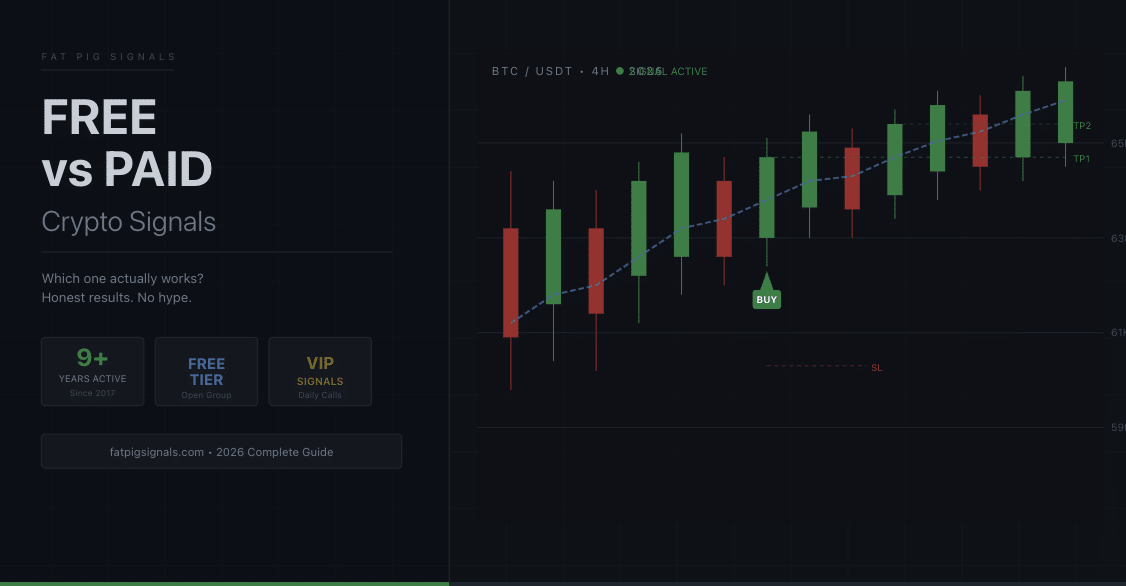
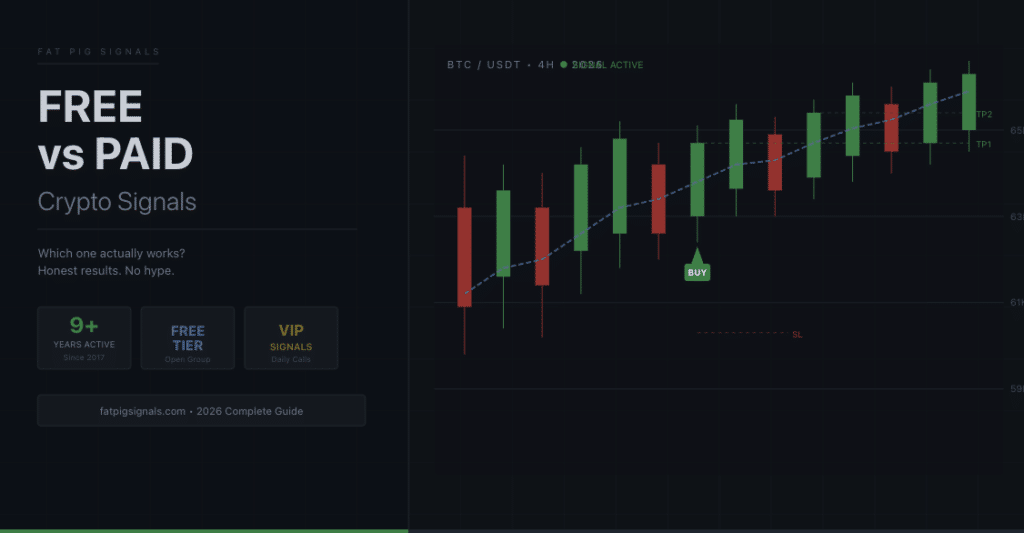
BTC/USDT LONG Entry: $62,500 Take Profit 1: $64,000 Take Profit 2: $67,500 Stop Loss: $60,800
That's the idea. Someone with more experience does the analysis. You execute the trade. Simple in theory — but the quality gap between a good signal and a bad one can mean the difference between growing your account and wiping it out.
Free Crypto Signals: What You're Actually Getting
Free Telegram groups for crypto signals are everywhere. Some have tens of thousands of members. But here's what most beginners don't realize:
Free signals are almost never the real product.
They're a marketing tool.
A legitimate provider uses a free group to show you a taste of what they do — build trust, demonstrate accuracy, and eventually invite you to upgrade to VIP. A scam provider uses a free group to build a following, manufacture fake hype, and eventually run a pump-and-dump or push paid subscriptions that deliver nothing.
So free signals aren't inherently bad. But you need to know what "good free" looks like versus "trap free."
What Good Free Signals Look Like
- Publicly tracked results. If a group shares signals, they should also share outcomes — wins and losses. A spreadsheet, a pinned results post, something verifiable.
- Real analysis included. Not just "buy BTC now." Good signals explain why — support levels, trend direction, news catalyst.
- Stop losses on every call. Any signal without a stop loss is not protecting you. Full stop.
- Transparent about losses. Every trader loses sometimes. A group that only posts wins is cherry-picking or lying.
Red Flags in Free Signal Groups
Common Mistake: A group with 50,000 members posting 20 signals a day is not impressive — they're just increasing the odds that a few randomly hit so they can screenshot the winners.
Watch out for:
- No loss history. If every signal is a "10x" and nothing ever goes wrong, they're hiding the truth.
- Urgency tactics. "Buy NOW or miss it!" is a pump signal, not a trade signal.
- No entry/stop/target structure. A signal without risk management is just a price shout. Useless.
- Admin contacts you privately to sell something. This is almost always a scam. Legitimate groups don't DM members to sell investments or "managed funds."
- Fake reviews and screenshots. Easy to fabricate. Look for third-party review sites like Trustpilot for verified feedback.
Paid Crypto Signals: What You're Actually Paying For
A paid signal service isn't just signals — it's access to a professional trader's analysis workflow.
Here's what separates a genuinely valuable paid tier from a free group:
1. More Signals, More Markets
Free groups often post 1–3 signals per week. VIP channels from experienced providers typically post daily, cover more pairs (altcoins, Bitcoin futures, specific exchange opportunities), and react faster to market shifts.
2. Detailed Trade Analysis
Premium signals usually include a full breakdown: the chart pattern they're trading, the trend context, the risk-to-reward ratio, and sometimes even a video or voice note walkthrough. You're not just getting a trade — you're learning how to think about it.
3. Real-Time Alerts
Markets move fast. A paid service typically sends alerts the moment conditions are right, not hours later after the entry has already passed.
4. Risk Management Guidance
The single biggest difference. Paid providers tell you how much of your account to risk per trade — usually expressed as a percentage (like 1–2% per signal). This is called position sizing, and it's what separates traders who survive from traders who blow up their accounts.
5. Community and Education
The best paid signal communities aren't just Telegram channels — they're active trading communities where members share analysis, ask questions, and learn from each other. Over time, you stop just following signals and start understanding why they work.
The Honest Comparison
| Free Signals | Paid Signals | |
|---|---|---|
| Cost | $0 | $50–$200+/month |
| Signal frequency | 1–5/week | Daily+ |
| Analysis included | Rarely | Usually yes |
| Stop loss on every trade | Sometimes | Should always be yes |
| Transparent results | Rarely | Depends on provider |
| Risk management guidance | Almost never | Often yes |
| Community support | Variable | Usually stronger |
| Scam risk | High | Lower (but still verify) |
The honest truth? Most free signals are a waste of your time. Not because free automatically means bad — but because the incentives in free groups are misaligned. When a provider doesn't earn from signal quality, they don't optimize for signal quality.
But here's the flip side: not all paid signals are worth paying for either.
Paying $200/month for a Telegram group that posts 2 signals a week with no analysis and a 40% win rate is worse than saving your money.
How to Evaluate Any Signal Provider (Free or Paid)
Before you join any group — free or paid — run through this checklist:
1. Can you verify their historical results? Look for a linked spreadsheet, a pinned post, or a third-party review. Real results include losses. If you only see wins, walk away.
2. Do they use stop losses on every signal? Non-negotiable. A trader who doesn't protect your downside doesn't deserve your attention.
3. How long have they been operating? Anyone can run a signal group for 3 months in a bull market and look like a genius. Look for groups with a multi-year track record across different market conditions — bull runs, crashes, sideways markets.
4. Is there a free tier to test first? A legitimate provider lets you see a sample of their work before you pay. If there's no free access at all, be more cautious.
5. Do they educate, or just call trades? Providers who explain their reasoning are building your skills. Providers who just say "buy this now" are building your dependency on them. One of these is better for you long-term.
6. Are admins reachable and transparent? Can you contact them? Are their social profiles real? Is there a legitimate website with history, reviews, and verifiable information? Scam groups disappear overnight.
Real Example: What a 9-Year Track Record Looks Like
Pro Tip: One of the best ways to evaluate a provider is to look at how they performed during the worst market conditions — the 2022 bear market, the FTX collapse, the 2020 COVID crash.
Fat Pig Signals has been operating since 2017 — nearly a decade. That means their signals have been tested through multiple Bitcoin cycles: the 2017 bull run and crash, the 2018–2019 bear market, the 2020 pandemic drop, the 2021 all-time highs, the brutal 2022 collapse, and the current cycle.
Their free Telegram group lets you watch their approach before committing. Every trade includes entry zones, stop losses, and take profit targets. Their historical results — including losses — are publicly tracked.
That's the kind of transparency you should demand from any provider.
Check their free signals on Telegram here →
When Should You Upgrade to Paid?
Here's the practical decision framework:
Stay free if:
- You're still learning what signals even are
- You haven't made your first trade yet
- You want to verify a provider's accuracy before spending money
- Your trading account is under $500
Consider paid when:
- You're ready to trade with real money and want higher-frequency signals
- You want the full analysis, not just entry/exit numbers
The general rule: if the paid subscription costs more than 10% of your monthly trading capital, it's too expensive for your current stage. Build up first.
The #1 Mistake Beginners Make With Signals
They follow signals without understanding risk management.
A signal tells you what to trade. Risk management tells you how much to put in. Without the second part, even a high-accuracy signal provider can drain your account — because one big loss without a stop loss can wipe out 10 winning trades.
Here's the simple rule: never risk more than 1–2% of your account on a single trade.
If you have $1,000 in your account, that's $10–$20 per trade at risk. Not $1,000. Not even $100.
This sounds boring. It is boring. It's also the only reason professional traders are still trading 5 years later while beginners are looking for their next account top-up.
Quick Recap
Here's what we covered:
- Free signals aren't useless — but most free groups are marketing funnels, not genuine services. Verify before you follow.
- The key markers of quality: transparent results (including losses), stop losses on every signal, real analysis, multi-year track record.
- Red flags: no loss history, urgency tactics, private DMs selling investment plans, unverifiable screenshots.
- Paid signals are worth it when: your account is large enough, you've verified the free tier, and the provider educates — not just signals.
- Risk management beats signal accuracy. A 60% win rate with proper position sizing beats a 90% win rate with reckless sizing every time.
Your Next Steps
1. Today: Join a legitimate free Telegram signals group and watch — don't trade — for two weeks. Note how many signals hit their targets, how many hit their stop losses, and whether losses are acknowledged honestly.
2. This week: Spend 30 minutes learning position sizing. Search "1% risk rule crypto trading" — it's the single most important concept for beginners.
3. When you're ready: Evaluate the paid tier of any provider you've been following. If their free signals have been consistently quality for 4+ weeks, the paid tier is likely worth testing for one month.
The Fat Pig Signals free Telegram group is a good place to start — it's been running since 2017 with publicly verified results, and the free channel shows you exactly how they operate before you spend a cent.
Join the free Fat Pig Signals Telegram here →
You don't have to figure this out alone. Good signal communities don't just send trades — they help you become a better trader. That's what you're actually looking for.
Disclaimer: This article is for educational purposes only and should not be considered financial advice. Cryptocurrency trading involves substantial risk of loss. Past signal performance does not guarantee future results. Always do your own research and consider your risk tolerance before trading.
Related Articles
Free vs Paid Crypto Signals: Is Premium Worth It?
How to Read Crypto Charts for Beginners