How to Avoid Revenge Trading in Crypto (5-Step Behavioral System That Works)
Signals, Trading
You just lost a trade.
Maybe it hit the stop loss by a few cents before reversing. Maybe you made a mistake. Maybe the market was just random. It doesn't matter.
What matters is what happens in the next 90 seconds.
A voice in your head says: "One more trade. Get back to even. You know this setup works." Your hand is moving toward the keyboard. You're already entering a position before you've actually looked at the chart.
That's revenge trading. And if you're honest with yourself, you've done it.
Here's what nobody tells you: "just walk away" is not a strategy. When your cortisol is spiking and your rational brain has gone offline, willpower doesn't work. You need a behavioural system — specific rules written down before you open a chart — because the moment after a loss is precisely when your judgement is worst and you need your decisions made in advance.
This guide gives you that system. Five concrete steps, backed by what the neuroscience actually says about why revenge trading happens, and why most advice about it is useless.
Why "Just Be More Disciplined" Never Works
Most articles on revenge trading end with something like: "Stay calm, stick to your plan, and don't let emotions control you."
That advice is correct. It's also completely useless in the moment.
Here's what's actually happening in your brain when you take a loss.
The amygdala — the part of your brain responsible for threat detection and fight-or-flight responses — registers a financial loss as a genuine threat. Cortisol floods your system. Activity in the prefrontal cortex (the rational decision-making region) decreases significantly. Your brain is now operating in survival mode.
In survival mode, "fight" looks like taking another trade immediately. It feels rational — you're not angry, you're just solving the problem of being in the red. But the system you're using to make that decision is running on compromised hardware.
Research in behavioural psychology consistently shows that humans feel losses roughly twice as intensely as equivalent gains. A $200 loss feels as bad as a $400 win feels good. That asymmetry is what makes the "get back to breakeven" impulse so powerful — it's not logic, it's biology.
And there's something even more dangerous: revenge trading occasionally works.
The third revenge trade recovers the first two losses. Your brain records this as confirmation: "See — I was right to keep going." This is exactly how gambling addictions form. Intermittent reinforcement — a win inside a losing pattern — is more psychologically powerful than consistent moderate wins. One accidental win makes the next revenge trade feel even more justified.
You cannot willpower your way out of this. You need a system.
The 5-Step Behavioral System
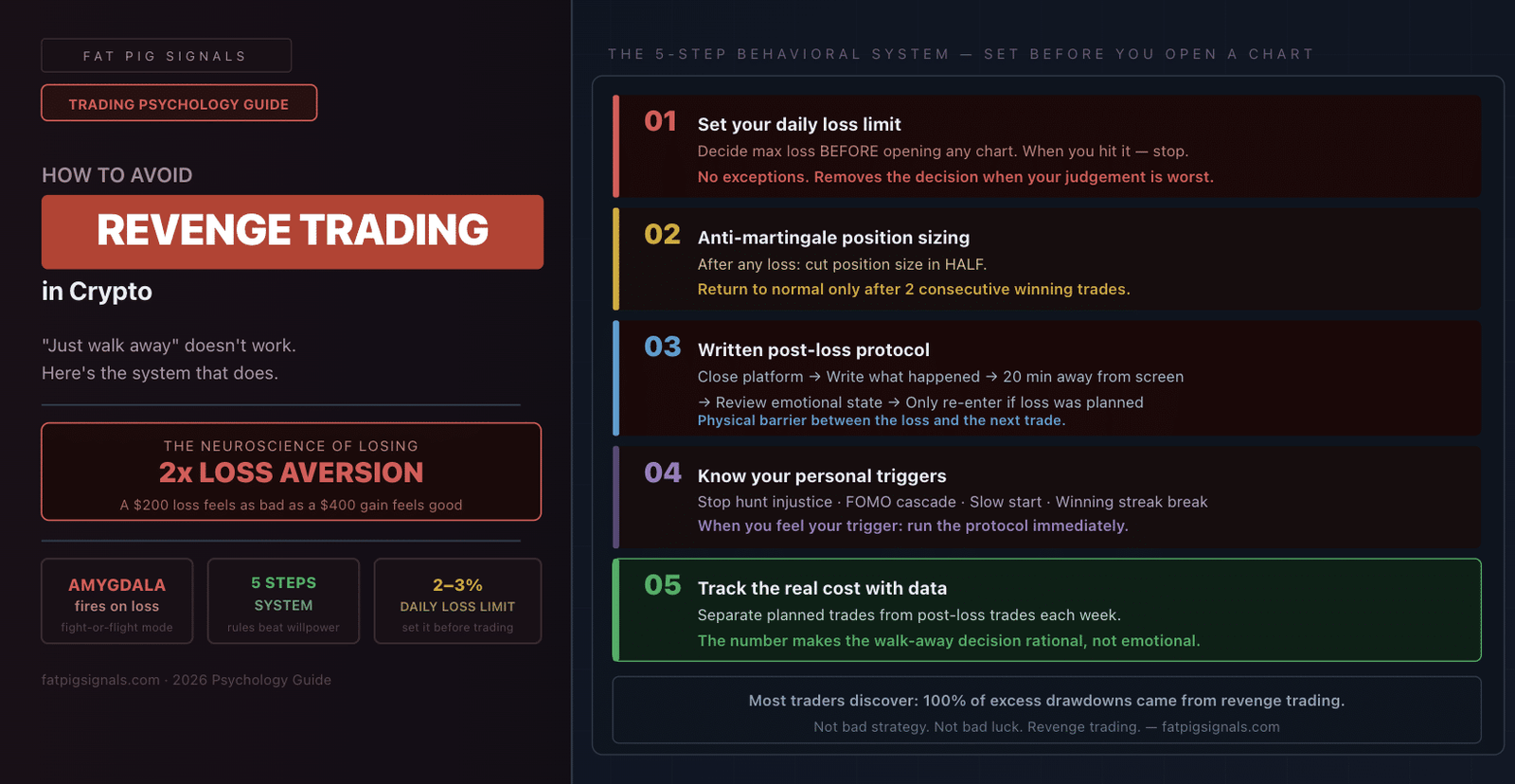
Step 1: Set Your Daily Loss Limit Before You Open a Single Chart
This is the foundational rule that everything else builds on — and it must be decided when you're calm, not after you're already down.
A daily loss limit is a predetermined number: the maximum amount your account can lose in a single session before you stop trading for the day. When you hit it, you close everything and don't open another position until tomorrow. No exceptions. No "one more setup." Closed.
Professional traders and prop firms use daily loss limits as standard practice — typically 2–3% of account value. The reasoning is simple: beyond that threshold, you are almost certainly not trading your strategy. You're trading emotion. And emotion-driven trades have a dramatically worse win rate than plan-driven trades.
The rule in practice: If your account is $5,000, your daily loss limit might be $100–$150 (2–3%). When you hit that number, trading is over for the day. This isn't about the money — it's about removing the decision from your hands before the worst version of yourself is making it.
Write this number down. Put it where you can see it before you start trading. Make it boring and automatic, not a choice you make under pressure.
Pro Tip: Audit your last 30 trading days. Identify every session where you went beyond your "normal" loss and kept trading to recover. Add up those additional losses. That number — not your strategy's losing trades — is what revenge trading is costing you.
Step 2: Lock Your Position Size After a Loss
The most insidious form of revenge trading isn't the dramatic version where you smash the keyboard and double down. It's the quiet escalation.
You lose your first trade. Your next entry is slightly outside your criteria — but close enough to justify. Then the next one is a little further outside. By the fourth trade, your position size has crept up and you're taking setups you'd never touch on a normal day.
The fix: anti-martingale position sizing.
After any losing trade, cut your next position size in half. Return to normal size only after two consecutive winning trades.
This does two things. First, it mathematically limits the damage during a losing streak. Second — and this is the part most people miss — it psychologically shifts your focus from recovering losses to rebuilding with small wins. Smaller positions feel less threatening, which keeps the amygdala calmer, which keeps the prefrontal cortex online, which means better decisions.
Martingale (doubling after losses) is what revenge traders instinctively do. Anti-martingale is what survives.
Step 3: Build a Written Post-Loss Protocol
This is the single most effective tool against revenge trading — and the least used.
A post-loss protocol is a written sequence of steps you execute after any losing trade, before you're allowed to enter another position. It removes the decision-making gap where revenge trading lives.
Here's a template that works:
After any losing trade:
- Close the trading platform entirely — not minimise, close
- Write down what happened: did you follow your rules? Was this a clean planned loss or an error?
- Take at least 20 minutes away from the screen
- Return and review: is the loss within your daily limit? Is your emotional state neutral?
- Only re-enter the market if both answers are yes and a valid setup exists right now — not "I think one's forming"
The key is step one. Closing the platform creates a physical barrier between the loss and the next trade. Minimising it means the chart is still there, pulling at you.
Common Mistake: Writing the protocol after you've already revenge traded. It needs to exist before you open a single position. Print it out. Put it next to your screen. When you close a loss, you open the protocol, not the chart.
Step 4: Identify Your Personal Revenge Trading Triggers
Revenge trading has different entry points for different people. Until you know yours, you can't interrupt the pattern early enough.
The four most common triggers:
The Stop Hunt: Price hits your stop loss by a few ticks and immediately reverses. You feel cheated. The market "did it deliberately." This feeling of injustice is one of the strongest revenge trade triggers because it feels righteous — you were right, the market just manipulated you.
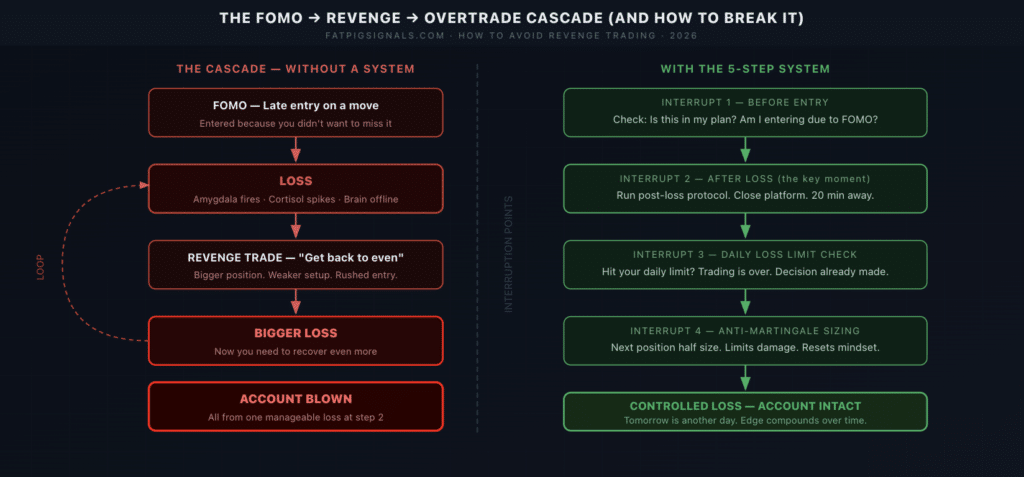
The FOMO→Loss Cascade: You entered a trade late because you didn't want to miss it. It went against you. Now you're down on a trade you know you shouldn't have taken, which compounds the frustration. This is what research calls the FOMO→revenge→overtrade sequence — not three separate problems but one cascade.
The Slow Start: You're down early in the session and you feel the day slipping away. Every trade that doesn't work is making the "fix" feel more urgent.
The Winning Streak Break: You'd been on a run. Three winners in a row. Then a loss. The contrast effect makes the loss feel much worse than it is — you were on a roll and now you're "off." This trigger is subtle because it doesn't feel emotional. It feels like frustration at a disruption.
Write down which of these hits you hardest. That's your highest-risk moment. When you notice yourself feeling that specific emotion, treat it as an automatic trigger for the post-loss protocol — even if you haven't lost money yet.
Step 5: Track the Real Cost With Data
The final step is the one that makes the system self-reinforcing.
At the end of every trading week, do one specific audit: separate your planned trades from your post-loss trades. Calculate the win rate and average P&L for each group separately.
Almost every trader who does this honestly for the first time discovers the same thing: their planned trades are profitable, or at least breakeven. Their post-loss trades are where all the damage is. Not bad strategy. Not bad luck. Revenge trading.
When you can see that number — "my revenge trades cost me $340 last month" — it stops being an abstract psychology problem and becomes a concrete, fixable performance issue. Data makes the walk-away decision rational rather than willpower-dependent.
This is also why structured signals with pre-defined entry points, stop losses, and take profit levels help break the revenge trading pattern: when a signal tells you there's no valid setup right now, the decision to wait is made for you. The chart says "nothing here." You're off the hook.
The Fat Pig Signals free Telegram group posts signals with this complete structure — and just as importantly, signals that aren't posted when conditions don't warrant a trade. Watching how professional traders exercise restraint is one of the fastest ways to internalise it yourself.
Quick Recap
Here's the full 5-step system, distilled:
- Step 1 — Daily loss limit: Decide your maximum session loss before trading. When you hit it, stop. No exceptions. Written down, visible.
- Step 2 — Anti-martingale sizing: After any loss, cut position size in half. Return to normal only after two consecutive wins. This is the opposite of what revenge trading instinctively does.
- Step 3 — Written post-loss protocol: A physical sequence you run after every losing trade, before you're allowed to enter another. Closes the gap where revenge trading lives.
- Step 4 — Know your triggers: Stop hunt, FOMO cascade, slow start, broken winning streak. Identify yours and treat recognising it as an automatic trigger for the protocol.
- Step 5 — Track the data: Separate planned trades from post-loss trades. The cost of revenge trading, made visible, becomes impossible to ignore.
The neuroscience is clear: after a loss, your rational brain is temporarily offline and willpower doesn't work. Systems work. Rules set in advance work. Data works.
Your Next Steps
Today — before your next trade: Write down your daily loss limit and your post-loss protocol on paper. Not in a notes app. On paper, next to your screen. This exists before you open a position.
This week: Look back at your last month of trades. Can you identify any sessions where you took losses beyond your normal stop and kept trading? Add up those additional losses. That number is what a working system would have saved.
When you're ready: Notice how structured signals give you a natural pause point. When there's no valid setup in the Fat Pig Signals channel, there's nothing to chase — the decision to wait is already made. That external structure complements the internal system above better than either one alone.
Join the free Fat Pig Signals Telegram →
Trading is a game of surviving long enough to let your edge compound. Revenge trading is the shortest route out of that game. The five steps above aren't about willpower. They're about making the right decisions in advance, when your brain is actually capable of making them.
Disclaimer: This article is for educational purposes only and does not constitute financial advice. Cryptocurrency trading involves substantial risk of loss. Always conduct your own research and never trade with money you cannot afford to lose.
Related Articles
What Is Time Decay in Crypto Options? (And How to Get Paid by It)

Crypto alerts: how to trust them