
Understanding Market Capitalization and Trading Volume

Trading
“Why Is This Cheap Coin Still ‘Huge’?”
Have you ever looked at a crypto coin priced at $0.01 and thought, “Wow, this is cheap—I should buy it”? Or maybe you saw Bitcoin at tens of thousands of dollars and assumed it was already “too expensive.”
If so, you’re asking one of the most common beginner questions in crypto.
The truth is, price alone tells you almost nothing. What really matters are two numbers most beginners overlook: market capitalization and trading volume.
These two metrics help you understand:
- How big a crypto project really is
- How risky or stable it might be
- Whether people are actually trading it
By the end of this guide, you’ll know how to read these numbers confidently—and avoid some classic beginner traps.
Why Market Cap and Volume Matter Right Now
Crypto markets move fast. New coins appear daily, hype spreads instantly, and prices can jump or crash within hours. That’s exactly why market capitalization and trading volume matter more than ever. They help you cut through the noise and answer a simple question:
Is this coin actually worth paying attention to?
Experienced traders—including those sharing analysis inside the Fat Pig Signals community—look at these metrics before even thinking about entries or exits
Let’s break them down one at a time, slowly and clearly.
What Is Market Capitalization? (Explained Simply)
Market capitalization, often shortened to market cap, is the total value of a cryptocurrency. Here’s the definition in plain English: Market cap = price of one coin × number of coins in circulation
That’s it. No hidden math.
Think of It Like This
Imagine a pizza shop.
- Each slice costs $2
- There are 100 slices
The whole pizza shop is worth $200, not $2. Crypto works the same way.
A Simple Market Cap Example with Numbers
Let’s say:
- Coin A costs $1
- There are 1 billion coins
Market cap = $1 × 1,000,000,000 = $1 billion
Now another coin:
- Coin B costs $10
- There are 10 million coins
Market cap = $10 × 10,000,000 = $100 million
Even though Coin B costs more per coin, Coin A is 10× bigger.
This is why a cheap price does not mean a cheap project.
Why Market Cap Is More Important Than Price
Market cap helps you understand:
- Size – how big the project is
- Stability – how volatile it might be
- Risk level – how easily price can move
Generally speaking:
- Bigger market cap = more stability
- Smaller market cap = more risk (and sometimes more reward)
This doesn’t mean one is better—it just means they behave differently
Large-Cap, Mid-Cap, and Small-Cap Cryptos
Cryptocurrencies are often grouped by market cap size.
Large-Cap Cryptos
- Market cap in the billions
- Examples: Bitcoin, Ethereum
- Usually more stable, slower moves
Mid-Cap Cryptos
- Market cap in the hundreds of millions
- Balance between growth and risk
Small-Cap Cryptos
- Market cap under $100 million
- Can move fast, but very volatile
Think of it like cars:
- Large-cap = trucks (steady, strong)
- Mid-cap = sedans (balanced)
- Small-cap = motorcycles (fast, risky)
Common Beginner Mistake
“This coin is cheap, so it can easily be 10×.”
A coin with a huge supply may already be expensive in terms of market cap—even if the price looks tiny. Always check the market cap before price.
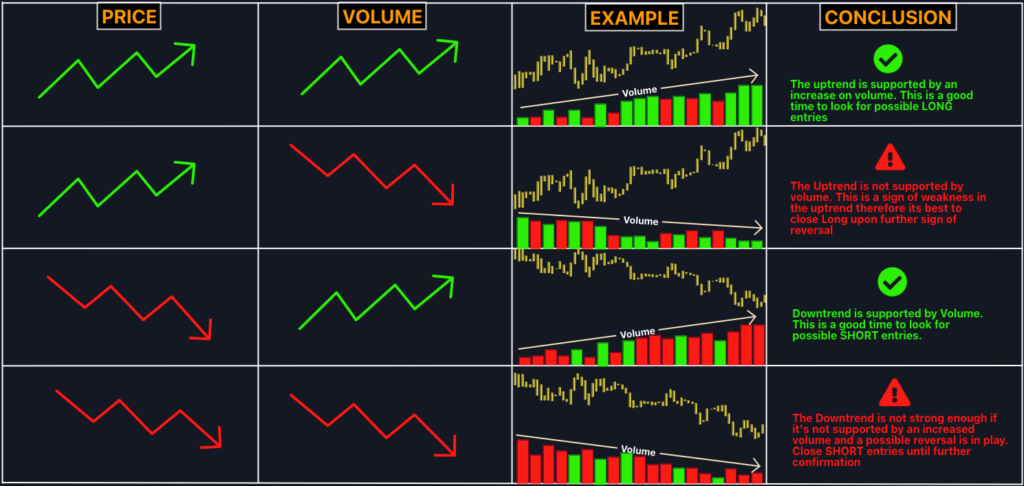
An Illustration of the Effects of Trading Volume. Image Source: quantvue
What Is Trading Volume?
Trading volume is the total amount of a coin traded over a specific time period, usually 24 hours.
In simple terms:
- It shows how active a coin is
- It tells you if people actually care about it
Think of It Like a Store
- Busy store = lots of customers (high volume)
- Empty store = no interest (low volume)
High volume means liquidity, which is just a fancy word for “easy to buy and sell.”
Trading Volume Example
Imagine:
- Coin X trades $500 million in 24 hours
- Coin Y trades $20,000 in 24 hours
Even if Coin Y looks promising, getting in and out may be difficult because no one is trading it.
This is why volume matters just as much as market cap
Why Trading Volume Matters for Your Trades
Volume helps you answer key questions:
- Can I enter and exit easily?
- Is this price move real or just hype?
- Are buyers or sellers in control?
Basic Volume Rules Beginners Can Use
- Rising price + rising volume = strong move
- Rising price + falling volume = weak move
- Big volume spike = something important is happening
You don’t need indicators yet—just observation.
Market Cap vs Trading Volume: How They Work Together
Market cap tells you size. Volume tells you activity. You need both.
Example Scenario
- Coin has a $5 billion market cap
- But only $5 million daily volume
That’s a warning sign. A big project should usually have strong activity.
On the flip side:
- Small market cap
- Huge volume spike
That can mean hype, news, or short-term speculation.
Pro Tip
Always compare volume to market cap, not just volume alone. A healthy coin usually has consistent volume relative to its size.
This is one reason traders often filter coins using both metrics before chart analysis.
How Beginners Can Use These Metrics
Here’s a simple process you can follow today:
- Check the coin’s market cap
- Identify if it’s large, mid, or small cap
- Look at 24-hour trading volume
- Ask: Is this coin actively traded for its size?
- Only then look at the price chart
This keeps you from wasting time on dead or risky coins.
Risk Reminder
Crypto trading involves risk.
- Market cap does not guarantee safety
- High volume does not guarantee profits
- Small caps can drop fast
Start small, learn gradually, and focus on understanding behavior, not chasing hype.
Quick Recap: Key Takeaways
Before we finish, let’s lock this in:
- Market cap = price × circulating supply
- Price alone is misleading
- Large-cap = more stable
- Small-cap = more volatile
- Trading volume shows activity and liquidity
- Use market cap and volume together—not separately
If this already feels clearer, you’re learning the right way.
Conclusion & Next Steps
Understanding market capitalization and trading volume helps you avoid beginner traps and focus on coins that actually matter.
Your next steps:
- Open a crypto tracker and compare market caps
- Check volume before analyzing charts
- Practice filtering coins using these two metrics
If you want to see how experienced traders apply these concepts in real market conditions, observing discussions and setups inside the Fat Pig Signals Telegram community can help you connect fundamentals with actual trading decisions
Take it slow. Learn one concept at a time. You’re building real trading skills—not gambling.
You’ve got this.
Related Articles
How to Spot Correction Warning Signs to Protect Your Portfolio

Step by Step Guide to Building a Crypto Trading Plan