
What Is the Best Leverage for Crypto Futures Trading? (Why Lower Is Almost Always Better)
Signals
Open any crypto exchange and you'll see it immediately: a slider that goes up to 100x. Sometimes 125x. On some platforms, even higher.
It looks like a feature. It feels like an upgrade. More leverage, more profit — right?
Here's the number that should change how you think about that slider: a 1% price move against you at 100x leverage wipes out your entire position. Not a bad day. Not a rough week. Gone, completely, from a movement so small you'd barely notice it on a daily chart.
This article explains exactly what leverage is, why exchanges push you toward dangerous levels, what professional traders actually use, and how to pick a leverage level that lets you stay in the game long enough to actually learn it.
What Is Leverage, Actually?
Leverage lets you control a larger position than your actual capital would normally allow, by borrowing the difference from the exchange.
If you have $100 and use 10x leverage, you're controlling a $1,000 position. The exchange is effectively lending you the other $900. Your $100 acts as collateral — money held as security in case the trade goes wrong.
This cuts both ways, and that's the part that gets lost in marketing.
If the price moves 5% in your favour with 10x leverage, your $100 gains 50% — that's a $50 profit. Exciting.
But if the price moves 5% against you, you lose 50% of your $100 — that's a $50 loss. And if it moves 10% against you, your entire $100 is gone. The exchange automatically closes your position to prevent further losses. This is called liquidation.
The higher your leverage, the smaller the price move needed to wipe you out completely.
The Liquidation Math Nobody Shows You
Here's the table that exchanges don't put next to their leverage slider — because it would scare off too many beginners.
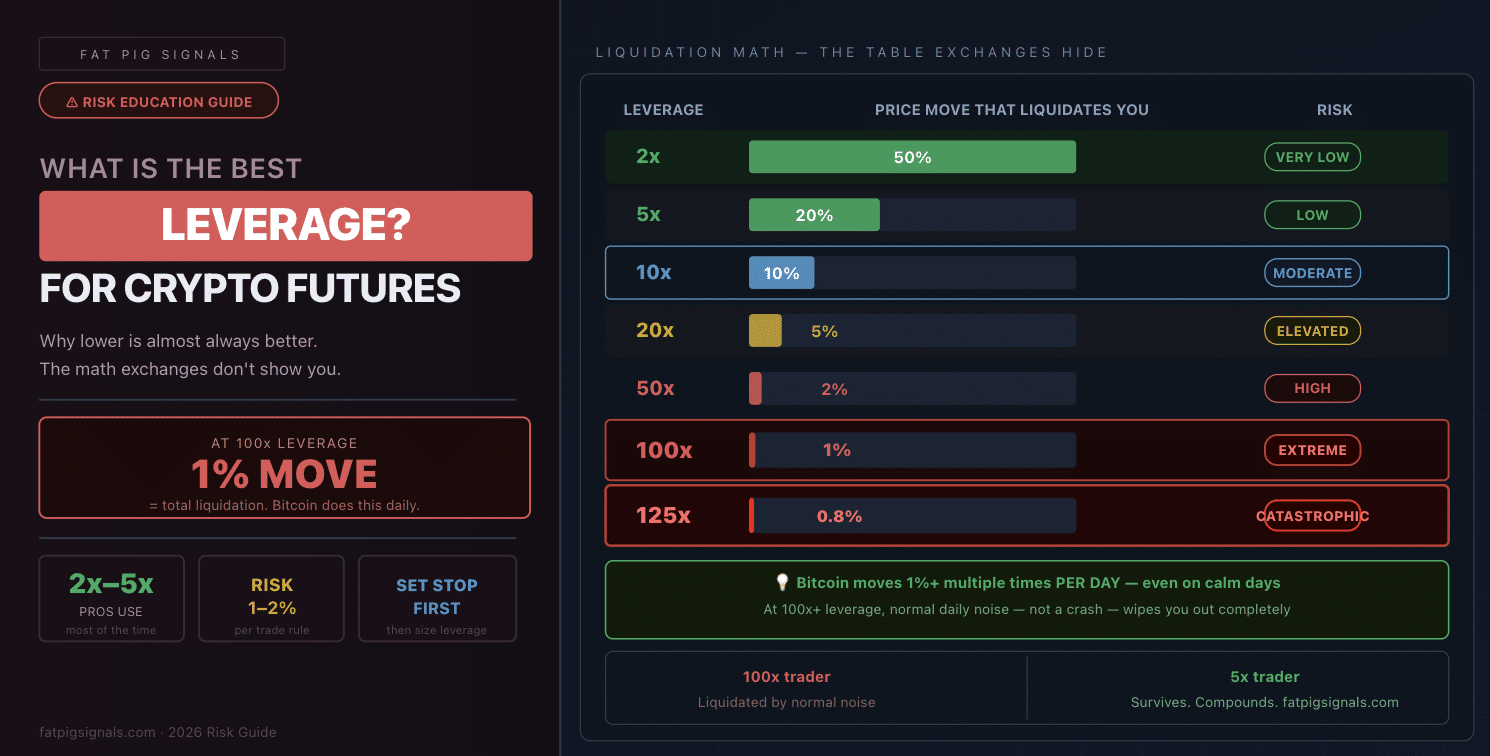
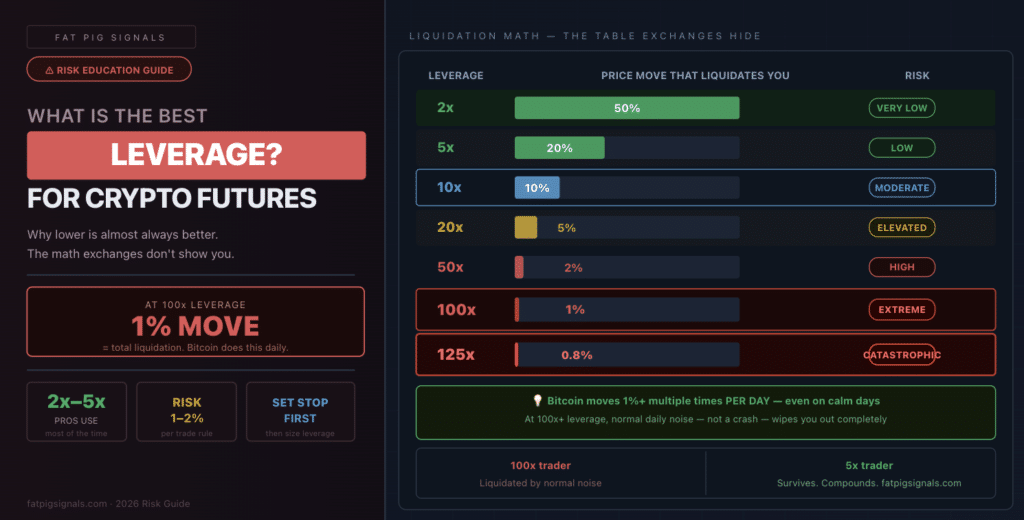
| Leverage | Price Move That Liquidates You |
|---|---|
| 2x | 50% |
| 5x | 20% |
| 10x | 10% |
| 20x | 5% |
| 50x | 2% |
| 100x | 1% |
| 125x | 0.8% |
Look at the bottom of that table. At 100x leverage, a 1% price move — something Bitcoin can do in minutes during normal volatility — completely liquidates your position.
Bitcoin moves 1% multiple times on an average day. Not during a crash. Not during big news. Just... Tuesday.
Common Mistake: Beginners see 100x leverage and think "I'll just use a small amount of money, so the risk is small." This misses the point entirely. The risk isn't about how much money you put in — it's about how little price movement it takes to lose all of it. High leverage means you can be right about the overall direction and still get liquidated by normal market noise before the move plays out.
Why Exchanges Push High Leverage
This isn't an accident or a generous feature. It's a business model.
Exchanges make money primarily through trading fees — a small percentage charged every time you open or close a position. Higher leverage means traders open and close positions more frequently, and lose money faster, which means more fee-generating activity and faster account turnover.
There's also a darker mechanic: many exchanges profit directly from liquidations. When your position gets liquidated, the exchange captures the remaining collateral and associated fees. A trader using 100x leverage who gets liquidated in an hour generates more revenue for the exchange than a trader using 5x leverage who holds a position for a week.
The slider going up to 125x isn't there because professional traders are clamouring for it. It's there because beginners click it, lose money fast, and the platform profits either way.
Pro Tip: The leverage options an exchange offers tell you nothing about what you should use. A car that can technically go 300 km/h doesn't mean that's the speed you should drive at on a normal road. The maximum available and the maximum sensible are two completely different numbers.
What Leverage Do Professional Traders Actually Use?
This is the question that changes everything once you know the answer.
Professional and institutional crypto traders — the people actually making consistent money in this market — typically use leverage in the 2x to 5x range for most positions. Some specialized strategies might use slightly higher, but the idea of regularly trading at 50x or 100x is, frankly, a beginner's mistake that professionals avoid entirely.
Why? Because professional traders aren't optimizing for "biggest possible win on one trade." They're optimizing for staying in the game long enough to compound gains over hundreds of trades.
A trader using 3x leverage who is wrong 40% of the time can still be highly profitable over a year, because their losses are survivable and their account stays intact between trades.
A trader using 50x leverage who is wrong even 20% of the time can have their account wiped out by a single bad trade — because the losses aren't proportional, they're catastrophic.
The math behind why lower leverage wins long-term:
Imagine two traders, both starting with $1,000, both making 20 trades over a few months.
Trader A (10x leverage): Wins 12 trades averaging +8% each gain on position size, loses 8 trades averaging -6% each. Account survives every loss. Account grows steadily.
Trader B (75x leverage): Wins the same 12 trades — but one of the 8 losses is a 2% price move against them, which at 75x leverage means total liquidation. Game over. The remaining winning trades that would have happened never get the chance.
The difference isn't trading skill. It's whether the account survives long enough for skill to compound.
How to Choose the Right Leverage for You
There's no single "correct" leverage number for every person and every trade. But there is a framework that works.
Step 1: Start With Your Risk Per Trade — Not Your Leverage
Before thinking about leverage at all, decide how much of your total account you're willing to risk on a single trade. The professional standard is 1–2% of your account per trade.
This number — your risk per trade — should drive your position size and stop loss placement. Leverage is just a tool that determines how much capital you need to put up as collateral for that position. It should never be the starting point of your decision.
Step 2: Set Your Stop Loss Based on the Chart, Not the Leverage
Your stop loss level should be determined by technical analysis — where does the trade idea actually get invalidated based on support, resistance, or trend structure? Not "where can I afford to put my stop loss based on my leverage."
If your leverage forces your stop loss to be unrealistically tight (because higher leverage means smaller room before liquidation), that's a sign your leverage is too high for the trade — not a reason to ignore proper chart analysis.
Step 3: Match Leverage to the Strategy Type
Beginners (first 6–12 months): Stick to 2x–5x leverage maximum. Your goal right now isn't maximum profit — it's learning to read charts, manage risk, and develop discipline without your account getting wiped out by normal volatility.
Intermediate traders with consistent results: 5x–10x can be appropriate for high-conviction setups with tight, well-reasoned stop losses, provided overall account risk per trade still stays at 1–2%.
Experienced traders managing serious capital: Even at this level, leverage rarely exceeds 10x–20x for sustained positions. Higher leverage is occasionally used for very short-term, high-precision trades by people with years of consistent profitability — not as a default setting.
Common Mistake: Increasing leverage after a losing streak to "win it back faster." This is one of the most destructive patterns in trading. It takes a manageable loss and turns it into the kind of single catastrophic event that ends accounts completely.
A Real Comparison: Same Trade, Different Leverage
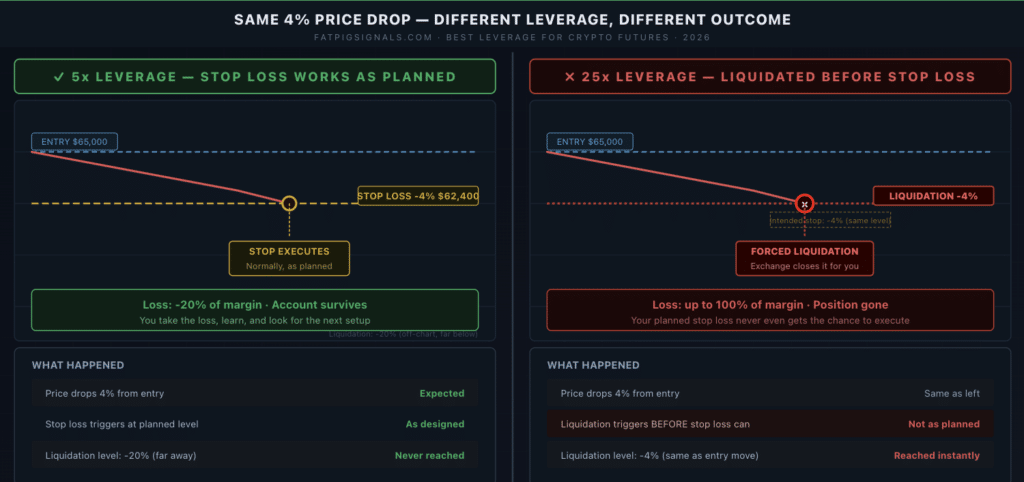
Let's say you've analysed Bitcoin and you're confident in a long position with a stop loss 4% below your entry — based on a clear support level on the chart.
Using 5x leverage:
- A 4% adverse move triggers your stop loss
- You lose 20% of your position's margin
- Account survives. You learn from the trade. You take the next setup.
Using 25x leverage:
- A 4% adverse move would trigger liquidation before your stop loss can even execute
- The exchange auto-closes your position at the worst possible moment
- You lose significantly more than planned, and possibly the entire position
Same chart analysis. Same stop loss level. Wildly different outcomes — purely because of the leverage multiplier attached to the position.
This is why leverage isn't a "more aggressive = more professional" setting. It's a risk amplifier that needs to match the actual trade structure you're using.
Quick Recap
Here's what we covered:
- Leverage lets you control a bigger position than your capital alone allows — but losses scale the same way gains do, in the opposite direction.
- The liquidation math is brutal at high leverage: 100x leverage means a 1% price move wipes you out completely. Bitcoin does that multiple times per day.
- Exchanges profit from high leverage and liquidations — the maximum available has nothing to do with what's sensible to use.
- Professional traders typically use 2x–5x leverage — they optimise for staying in the game, not for single-trade lottery wins.
- Decide your risk per trade first (1–2% of account), then your stop loss based on chart structure, then size your position and leverage to match — never the other way around.
- Beginners should stay at 2x–5x leverage maximum for at least the first 6–12 months of active trading.
Your Next Steps
Today: Check what leverage setting you currently have selected on your exchange. If it's above 10x and you're not an experienced trader, lower it now — before your next trade, not after a loss.
This week: Practice the math from this article. Pick any leverage level and calculate exactly what percentage price move would liquidate you. If that number makes you uncomfortable, that leverage is too high for you right now.
When you're ready: Apply this framework alongside structured signals that already include defined entry, stop loss, and take profit levels — so your leverage decision is paired with a complete risk management plan, not made in isolation.
The Fat Pig Signals free Telegram group posts signals with full structure — entries, targets, and stop losses included — which gives you a real reference point for how leverage and risk management work together in practice.
Join the free Fat Pig Signals Telegram →
Surviving long enough to get good at trading is the actual goal. Low leverage isn't the boring option — it's the one that lets you still be trading a year from now, with an account that's grown instead of disappeared.
Disclaimer: This article is for educational purposes only and does not constitute financial advice. Leveraged crypto trading carries substantial risk of loss, including total loss of invested capital. Always conduct your own research and never trade with money you cannot afford to lose.
Related Articles

High-Timeframe vs Low-Timeframe Crypto Signals: What Every Beginner Needs to Know
Bitcoin Options Strategy that Lets Traders Profit While Also Hedging