
What Is DCA in Crypto? How the Fat Pig Signals Portfolio Builder Turns Market Fear Into Long-Term Profit
News
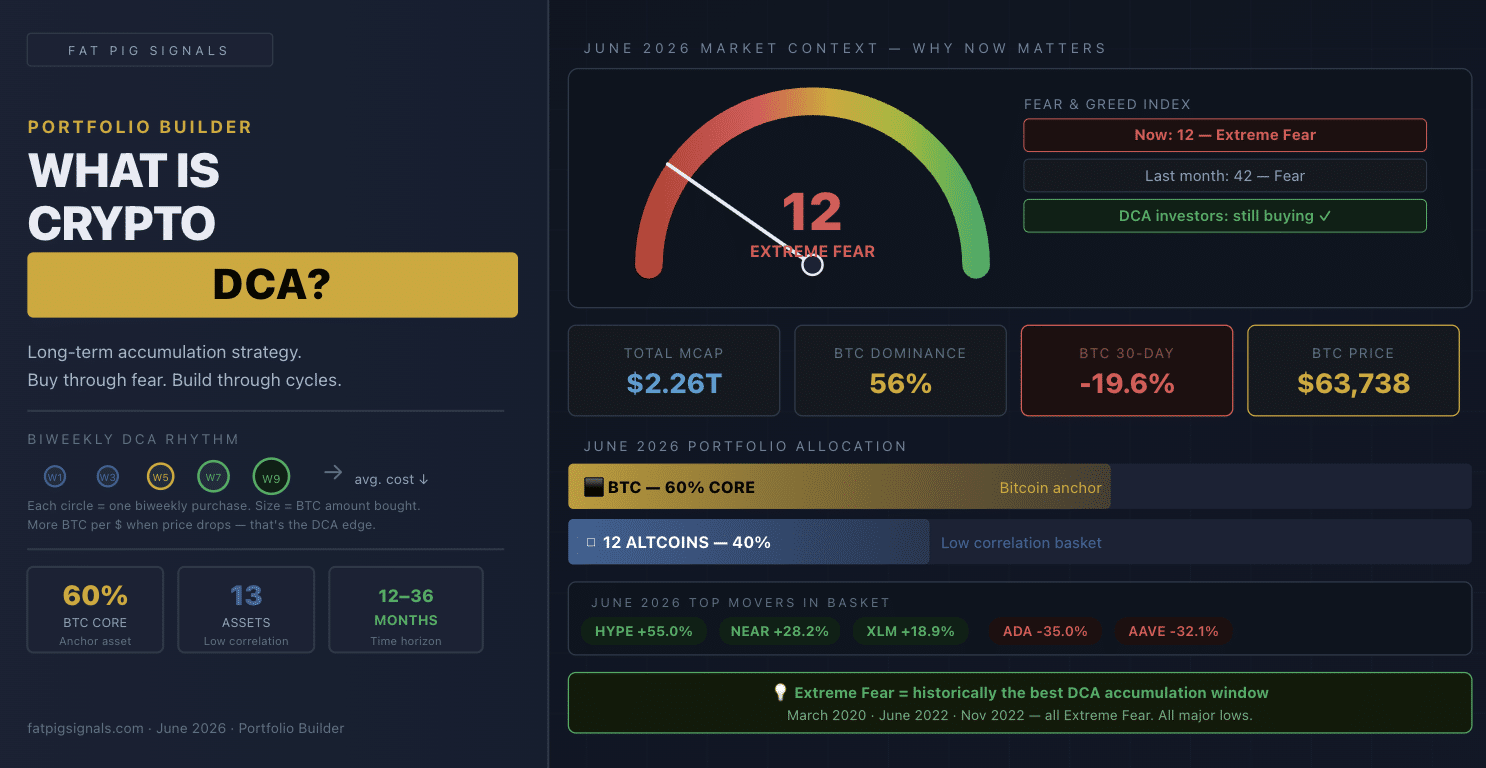
The Fear & Greed Index just hit 12.
That's "Extreme Fear" — the lowest reading on the sentiment scale. Bitcoin has pulled back 19.6% over the past month and is trading near $63,738. The total crypto market sits at $2.26 trillion. Social media is full of panic. Forums are predicting collapse.
And somewhere out there, a group of disciplined investors just made their biweekly purchase — exactly as planned.
They didn't check the chart before buying. They didn't wait for "confirmation." They didn't try to time the bottom. They just bought, the same amount, on the same schedule, like they do every two weeks.
This is what Dollar-Cost Averaging (DCA) looks like in practice. And when everyone else is panicking, it's quietly one of the most powerful strategies in crypto.
This article explains exactly what DCA is, why Extreme Fear markets are actually where long-term investors want to be buying, and how the Fat Pig Signals Portfolio Builder puts this into a structured, maintained system for people who want crypto exposure without the stress of active trading.
What Is DCA — Dollar-Cost Averaging?
Dollar-Cost Averaging (DCA) is a strategy where you invest a fixed amount of money at regular intervals — regardless of what the price is doing at that moment.
Instead of trying to buy at the perfect price (which nobody consistently gets right), you spread your purchases over time. Sometimes you buy when the price is high. Sometimes you buy when it's low. Over time, your average cost per coin smooths out — and you stop losing sleep over every 10% move.
Here's a simple example:
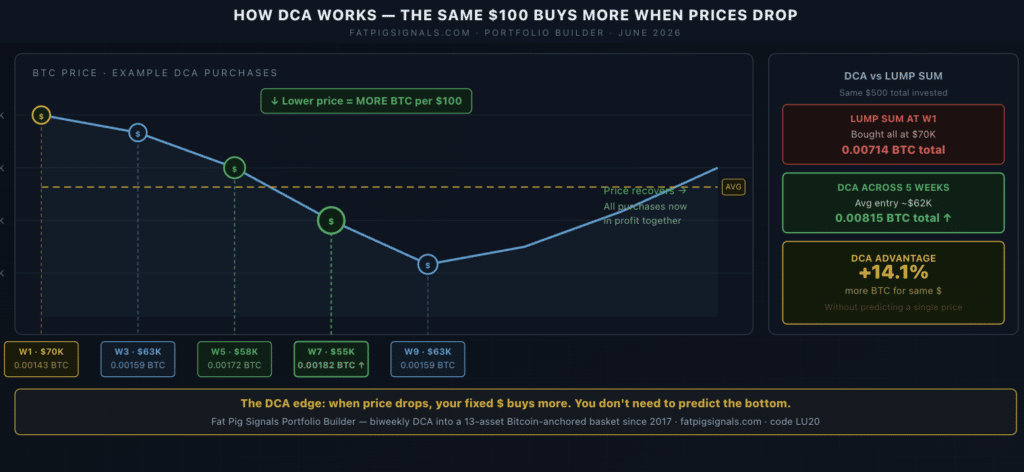
Imagine you invest $100 in Bitcoin every two weeks for six months:
- Week 1: BTC at $70,000 — you buy 0.00143 BTC
- Week 3: BTC at $63,000 — you buy 0.00159 BTC
- Week 5: BTC at $58,000 — you buy 0.00172 BTC
- Week 7: BTC at $55,000 — you buy 0.00182 BTC
Notice what happens: when the price drops, your $100 buys more Bitcoin. The pullback that terrifies short-term traders is the same event that improves your average entry price.
Over a 12-month period, a consistent DCA investor ends up with a better average cost than someone who tried to time the market and either missed the entry or panic sold along the way.
Pro Tip: DCA doesn't just reduce your emotional stress — it mathematically reduces your average entry cost during volatile, downtrending markets. That's exactly what we're in right now.
Why Extreme Fear Is Actually Good News for DCA Investors
Here's something counterintuitive about the current market.
The Fear & Greed Index is at 12 — Extreme Fear. It's been sitting there for weeks: 12 on June 12th, 12 on June 11th, 12 the week before. Last month it was at 42 (just "Fear"). The market has gotten measurably more scared.
Most retail investors interpret this as a signal to stop buying, wait it out, or sell everything.
But history tells a completely different story.
The Fear & Greed Index bottomed out at similarly extreme levels:
- March 2020 (COVID crash): Extreme Fear — Bitcoin was around $4,000. Within 18 months it hit $69,000.
- June 2022 (post-LUNA collapse): Extreme Fear — Bitcoin was around $17,000. By early 2024 it hit $73,000.
- November 2022 (FTX collapse): Extreme Fear — Bitcoin was around $16,000. The recovery that followed rewarded everyone who kept buying.
Extreme Fear doesn't guarantee the bottom is in. Nobody knows exactly when that is. But what it does tell you is that sentiment is at its worst — which historically marks the periods when patient, disciplined buyers accumulate assets that eventually recover and grow.
The people buying during Extreme Fear are not the people who panic at 19.6% drawdowns. They're the ones who already decided, before the drawdown started, that they would keep buying regardless.
That decision is made before the fear sets in. That's what a system does.
Common Mistake: Waiting for the Fear & Greed Index to turn green before buying. By the time sentiment recovers to "Greed," prices are already significantly higher. You've bought the feeling of safety — at a premium.
The Problem With "I'll Just Buy Bitcoin"
DCA into Bitcoin is a solid strategy. But there's a more sophisticated approach: building a portfolio of carefully selected crypto assets using DCA — not just Bitcoin alone.
Here's why this matters.
Bitcoin is the anchor of any serious crypto portfolio — and the Fat Pig Signals Portfolio Builder reflects this, with 60% allocated to Bitcoin as its core position. Bitcoin dominance in the current market is 56%, meaning it drives most of the market's direction.
But the remaining 40% — spread across 12 additional carefully selected liquid assets — is where the opportunity gets interesting.
This month's top performers in the portfolio universe tell the story clearly:
- HYPE: +55.0% this month
- NEAR: +28.2%
- XLM: +18.9%
These weren't random picks. They were selected based on their individual return profiles, risk characteristics, and — critically — their low correlation to each other. That last point matters more than most people realise.
Correlation measures how much two assets move together. If you hold 13 assets that all crash at the same time in the same way, you don't really have a diversified portfolio — you have a single bet with extra steps.
The Portfolio Builder specifically selects assets with lower cross-correlations. When Bitcoin drops, some of the altcoins in the basket may hold their value better, drop less, or even gain. This doesn't eliminate risk — nothing does — but it smooths the overall portfolio's volatility and improves the risk-adjusted return over time.
For June 2026, the target allocation carries a model-estimated annualised volatility of approximately 50%. That sounds high — and in any other asset class it would be. But for crypto, a diversified 13-asset portfolio at 50% volatility is genuinely more stable than holding single altcoins, most of which carry 80–120% annualised volatility on their own.
What the Fat Pig Signals Portfolio Builder Actually Is
Let's be specific about what this product is — because it's different from the swing trade signals most people think of first.
The Portfolio Builder is a long-term crypto accumulation strategy built around biweekly DCA.
Instead of sending you signals to buy and sell on short timeframes, it gives you a maintained, periodically reviewed target allocation across a Bitcoin-anchored basket of 13 liquid crypto assets. New contributions follow the target weights. The portfolio adjusts gradually over time through future DCA purchases — no abrupt changes, no panic rebalancing.
The current structure:
- 60% Bitcoin (BTC) — the core, the anchor, the foundation
- 40% spread across 12 selected altcoins — chosen for individual return profiles and low cross-correlations
The strategy has a designed time horizon of 12 to 36 months or longer. It is explicitly built for capital you can leave allocated for the long term — not money you need next month.
This distinction matters enormously. Most people underperform crypto markets not because they picked the wrong coins, but because they panicked during the inevitable drawdowns and sold at the wrong time. A system with a defined timeframe and a biweekly contribution schedule removes that human weakness from the equation.
The Portfolio Builder just resumed publication in June 2026 with a renewed allocation and an updated long-term framework. During the pause, additional liquid assets entered the research universe and have been integrated into the new Bitcoin-anchored allocation. Members don't need to make abrupt changes — the renewed allocation is approached gradually through future DCA contributions.
The Three Rules That Make DCA Work
If you take one thing from this article, make it this: DCA is not just a strategy. It's a commitment.
Here are the three rules that determine whether it works for you:
Rule 1: Buy every two weeks. No exceptions.
Fixed amount, fixed schedule. Don't skip a purchase because the market looks scary. Don't double up because it looks exciting. Consistency is the entire point.
The month where skipping feels most justified — when the Fear & Greed Index is at 12 and everyone is predicting further collapse — is often the month where buying delivers the best long-term results.
Rule 2: Follow the target weights.
Each contribution goes into the basket according to the target allocation — 60% Bitcoin, 40% across the selected altcoins. This isn't about picking the hottest coin of the week. It's about systematic accumulation of a diversified basket that's been researched and maintained for you.
Rule 3: Think in years, not weeks.
The Portfolio Builder is designed for a 12 to 36 month horizon, minimum. If you're checking your portfolio every day and feeling anxious about short-term movements, you're using a long-term tool on a short-term emotional timeframe.
The question isn't "what is my portfolio worth today?" It's "what will disciplined biweekly accumulation, maintained across a full crypto cycle, produce?"
History answers that question favourably — for every investor who had the patience to stay the course.
Who This Is For (And Who It Isn't)
The Portfolio Builder is right for you if:
- You believe in crypto's long-term trajectory but don't have time to actively trade
- You want exposure to the market without the stress of timing entries and exits
- You can commit capital for 12–36 months without needing it for living expenses
- You want a maintained, professionally researched allocation — not just "buy whatever is trending"
- You understand that volatility is part of the process, not a reason to exit
It's not for you if:
- You need short-term returns or regular liquidity from this capital
- You want to actively trade and capitalise on short-term price movements (that's what the swing trade signals are for)
- You're unable to maintain contributions during market downturns — the strategy breaks down if you stop buying during fear cycles
These are honest constraints. DCA as a strategy fails when people abandon it during the hard months. The entire edge comes from buying through the fear — not stopping because of it.
What This Market Moment Means in Plain English
Bitcoin is down 19.6% this month. Fear & Greed is at 12. The weakest performers in the portfolio universe — ADA (-35.0%), AAVE (-32.1%) — are showing significant drawdowns.
This is exactly the kind of month that feels terrible in real time.
It's also the kind of month that long-term DCA investors look back on in 18 months and think: that's when we were buying at the best prices of the cycle.
Nobody rings a bell at the bottom. But buying a diversified, Bitcoin-anchored basket of quality assets systematically through fear cycles — rather than trying to pick the exact floor — has consistently rewarded patient investors across every Bitcoin cycle since 2017.
The Portfolio Builder gives you the structure to do that. The research to know what to hold. And the allocation framework to maintain it through whatever the market does next.
Quick Recap
Here's what we covered:
- DCA (Dollar-Cost Averaging) means investing a fixed amount on a fixed schedule — regardless of price. It removes emotion and smooths your average entry cost over time.
- Extreme Fear (F&G at 12) has historically marked the best long-term accumulation periods — not reasons to stop buying.
- Diversification matters: a 13-asset portfolio with low cross-correlations carries meaningfully lower volatility than single-coin holdings.
- 60% Bitcoin is the anchor — the Portfolio Builder is Bitcoin-first, with selected altcoins for additional return potential.
- The three rules: buy every two weeks, follow the target weights, think in years not weeks.
- The edge breaks down if you stop — consistency through fear cycles is where all the long-term gains are made.
Your Next Steps
Step 1 — Today: Decide what amount you can invest biweekly without needing it for living expenses in the next 12–36 months. This is your DCA contribution. Not what you want to invest — what you can genuinely commit to without stress.
Step 2 — This week: Study the current market context. Fear & Greed at 12. Bitcoin at $63,738. Total market cap $2.26T. These are the conditions in which the Portfolio Builder's June 2026 allocation was researched and published. Understanding the context makes the strategy easier to follow.
Step 3 — When you're ready: Access the full Portfolio Builder through Fat Pig Signals VIP membership. The June 2026 allocation — the full 13-asset basket, target weights, and long-term framework — is available to VIP members.
The swing trade signals and the Portfolio Builder are two different tools for two different timeframes. Most serious members use both: signals for active short-term opportunities, Portfolio Builder for disciplined long-term accumulation.
Join Fat Pig Signals VIP → | View signal track record → | Join free Telegram →
The market is in Extreme Fear. The biweekly schedule doesn't care. The next purchase is already planned.
That's the point.
Disclaimer: This article is for educational purposes only and does not constitute financial advice. Cryptocurrency investments involve substantial risk of loss. Past performance does not guarantee future results. Only invest capital you can afford to hold for the long term. Always conduct your own research.
Related Articles

Utoday: Celsius Has $1.2 Billion Hole in Balance Sheet

Kraken's New Status in Canada: A Turning Point for Crypto