
What Is Time Decay in Crypto Options? (And How to Get Paid by It)
Bitcoin, Signals, Telegram, Trading
BTC is selling off.
Your portfolio is down. You're watching the chart. You're wondering if you should buy the dip, wait for lower prices, or do absolutely nothing.
Meanwhile, a different group of traders — the ones holding Bitcoin who sold a covered call against it — are sitting comfortably. They already collected cash when they opened the position. Every single day that passes, that cash becomes more securely theirs. They don't need Bitcoin to go up. They don't need it to hold perfectly steady. They just need time to keep moving.
That's the power of time decay — also called theta (the Greek letter Θ used to represent it). And understanding it might be the single most important concept most crypto traders have never heard of.
What Is Time Decay?
Every options contract has an expiration date — a deadline after which it becomes worthless (or gets exercised).
When you buy an option, you're paying for two things:
- Intrinsic value — the actual profit built into the contract if it expired right now
- Time value (also called extrinsic value) — the extra premium you pay for the possibility that the price could move further in your favour before expiration
As time passes, that time value slowly bleeds away. Every day that ticks by, the possibility window gets smaller. The option has less time to "become more valuable." So its price drops — just from the passage of time, even if the underlying asset price doesn't move at all.
That erosion of time value is theta decay — and it's relentless. It happens every single day, including weekends. In crypto, where markets run 24/7, the time you paid for is always shrinking.
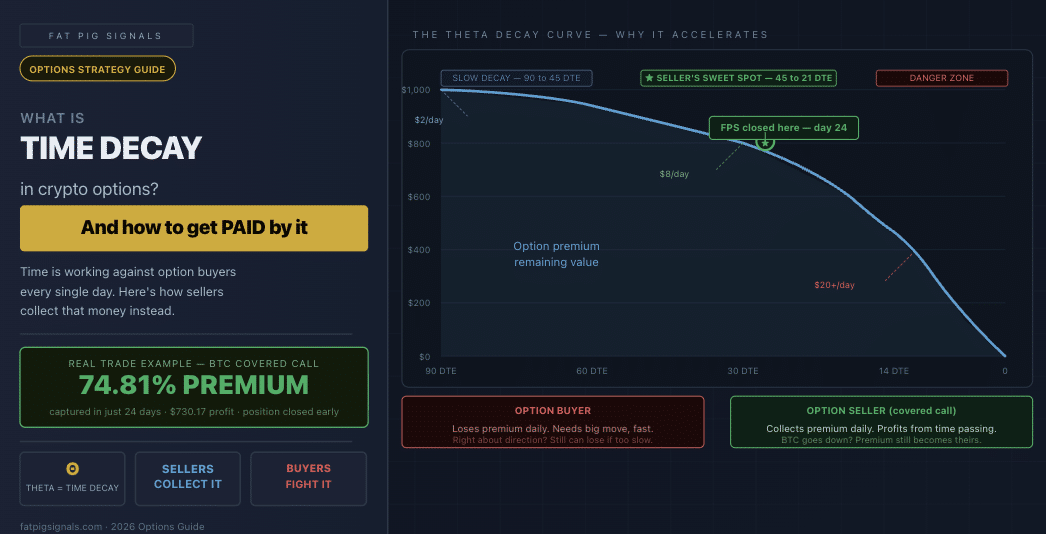
The ice cube analogy: Think of a block of ice left out in the hot summer sun. It melts throughout the day, but not evenly. The closer you get to noon, the faster it goes. Theta options behave the same way. An at-the-money option with 90 days to expiration loses time value much more slowly than the same option with 10 days left. As expiration approaches, the erosion accelerates sharply.
The key insight: An option is a wasting asset. Every day you hold it, it's worth slightly less — even if nothing else changes.
The Buyer's Problem and the Seller's Edge
Here's where it gets interesting — and where most beginners fundamentally misunderstand how options work.
Option buyers fight time decay.
If you buy a Bitcoin call option expecting BTC to rise, time is working against you from the moment you open the position. Every day that passes without the expected move, your option loses value. You can be right about the direction and still lose money if you're wrong about timing. Buy a call expecting a price rise, and if that move takes three weeks longer than you anticipated, theta decay may have already eaten through a significant portion of your position's value.
Option sellers collect time decay.
When you sell an option, you receive the premium upfront. Now the mechanics work in reverse: every day that passes, the option you sold becomes slightly cheaper to buy back. If you eventually close the position by buying back that option at a lower price than you sold it for, the difference is your profit — and time decay contributed to that difference automatically, regardless of what Bitcoin did.
When you sell an option, you collect a premium upfront. Every day that passes without the underlying moving against you, a portion of that premium decays, and that decay belongs to you.
This is why experienced options traders often say: "Buyers buy hope. Sellers sell time."
The Theta Curve: Why Decay Accelerates
Here's the part most articles skip — and it changes everything about when to enter and exit options positions.
Theta decay is not linear. It doesn't remove the same amount of value every day. It accelerates sharply as expiration approaches.
An ATM option with 90 DTE (days to expiration) might lose $2 per day. The same option with 14 DTE loses $8 per day. With 3 DTE, it's losing $20+ per day. This non-linear decay follows approximately a square root of time relationship and is the mathematical foundation of every premium selling strategy.
In practical terms:
- Between 90 and 45 days to expiration: slow, steady decay — sellers collect premium gradually
- Between 45 and 21 days: decay accelerates — the "sweet spot" for sellers
- Inside 14 days: decay becomes severe — dangerous for buyers, accelerating profits for sellers
For sellers, entering at 45 DTE and closing at 21 DTE captures the sweetest part of the curve: meaningful decay with manageable risk.
Common Mistake: Holding a long option into the final two weeks before expiration hoping it "finally moves." Buying out-of-the-money calls as a beginner theta strategy tends to be an expensive way to learn the market. The positions are cheap to enter. They are not cheap to hold.
Real Example: The Covered Call That Got Paid in a Falling Market
This isn't abstract theory. Here's exactly how time decay worked in practice — using a real trade executed by Fat Pig Signals VIP members.
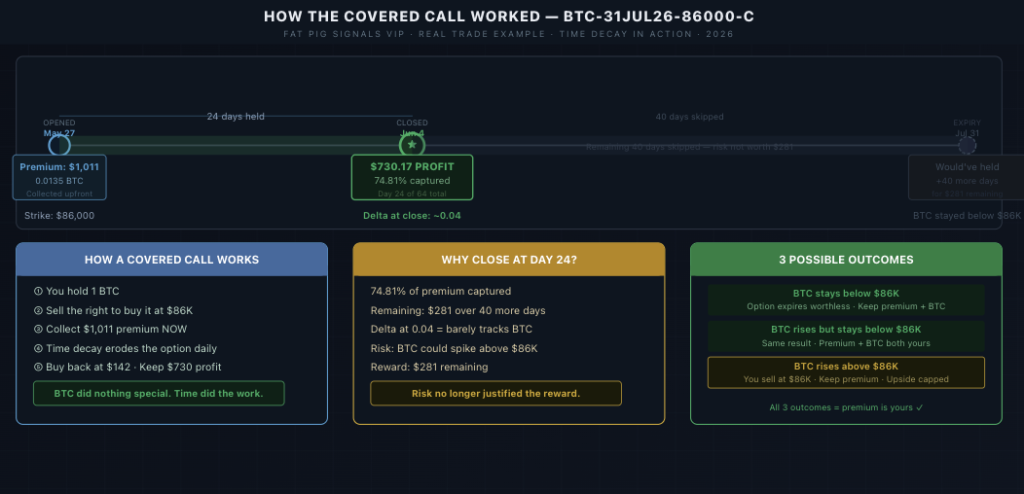
The trade: BTC-31JUL26-86000-C A Bitcoin covered call opened in late May 2026. Bitcoin was below $86,000. The goal: sell the right for someone else to buy BTC at $86,000 before July 31st, collect the premium for providing that option, and let time work.
The numbers:
- Premium received at open: 0.0135 BTC → $1,011.12
- Buyback cost 24 days later: 0.0022 BTC → $142.16
- Net profit: 0.0113 BTC → $730.17
- Premium captured: 74.81% in just 24 days out of a 64-day contract
The position was closed early — not at expiration. Why?
Because by day 24, the option's delta (a measure of how much it would move with Bitcoin's price) had dropped to around 0.04 — meaning the contract barely tracked BTC anymore. The remaining 25% of premium would require holding for another 40 days with meaningful risk that Bitcoin could spike through $86,000 and cap all upside.
The disciplined decision: lock in 74.81% of the available premium and step aside.
That's exactly what the Fat Pig Signals VIP options playbook looks like in action. Full breakdown of that trade — and others from May 2026 — is available on the Fat Pig Signals results page.
You can also read the complete May 2026 results article for the full picture of how signals and options performed side by side.
The Covered Call: Time Decay's Most Beginner-Friendly Strategy
The covered call is the cleanest entry point into options for someone who already holds crypto — and it's the strategy underpinning the trade above.
How it works in simple terms:
You own 1 BTC. Instead of just holding it and waiting for the price to go up (which may or may not happen), you sell a call option — you give someone else the right to buy your BTC at a higher price (say $86,000) before a specific date.
In exchange, they pay you a premium right now. Cash. Immediately.
Three possible outcomes:
- Bitcoin stays below $86,000: The option expires worthless. You keep the premium and your BTC. Repeat.
- Bitcoin rises but stays below $86,000: Option expires. You keep premium and BTC. Repeat.
- Bitcoin rises above $86,000: You sell your BTC at $86,000 (the agreed price). You keep the premium but give up any gains above $86,000. Your upside is capped — but you still profit.
This is why covered calls are considered one of the most conservative options strategies. The covered call is one of the most straightforward examples of a theta-positive strategy. The premium received reflects the market's expectation of movement before expiration. As long as Bitcoin stays below the strike, theta works in the seller's favour every single day.
The key discipline: only sell covered calls "when the setup is favorable" — meaning when implied volatility is elevated (higher premiums available) and when the strike price is far enough above the current price that you're genuinely comfortable potentially selling at that level.
This is not a "set and forget" strategy. It requires monitoring, and — critically — knowing when to close early (like day 24 in the example above) rather than holding to expiration chasing the last few percent of premium at disproportionate risk.
Why Crypto's Volatility Actually Helps Options Sellers
You might think high crypto volatility would make options selling more risky. In some ways, it does — but it also creates a significant advantage.
In crypto, where implied volatility is notoriously high and the markets are 24/7, Theta decay is relentlessly aggressive.
Higher volatility = higher premiums collected. When the market expects bigger moves, buyers pay more for the protection or leverage that options provide. Sellers collect more premium for the same risk.
The Bitcoin options market has grown dramatically to reflect this. Deribit processed $79.54 billion in BTC options alone during February 2026, and the exchange's total 2025 traded volume across all products reached approximately $1.875 trillion. That's institutional-scale money recognising that options — and particularly premium selling — belongs in a serious crypto portfolio.
Retail traders who understand this dynamic are accessing the same edge that professional options desks use. The difference is discipline: knowing which setups to take, how much premium justifies the trade, and — crucially — when to close early.
To learn more about how options work on the world's leading crypto options exchange, Deribit's learning resources are worth exploring alongside the concepts covered here. For a deeper dive into the mathematics of theta, CoinGecko's Bitcoin options theta guide provides a strong technical foundation.
Time Decay vs. Leverage: A Different Kind of Edge
If you've read our guide to crypto futures leverage, you know that leveraged futures trading creates a situation where you're fighting against volatility — a big move against your position at the wrong time wipes you out.
Options selling — specifically covered calls — works differently. You're not fighting volatility. You're collecting payment for tolerating it.
The premium you receive compensates you for the uncertainty of holding Bitcoin through volatile periods. If BTC drops 10% over the next month, you still keep the premium you collected. That premium reduces your effective purchase price, cushions the drawdown, and lets you look at a falling chart with considerably more composure than someone who's just holding with no income on the position.
This doesn't eliminate risk — nothing does. But it's a meaningfully different type of edge than directional trading, and it's one that works in sideways and falling markets as well as rising ones.
For a full picture of what professional risk management looks like — across both signals and options strategies — the Fat Pig Signals results page shows the full track record since 2017, wins and losses both included. That's the transparency standard described in our guide to finding a reliable signal provider.
Quick Recap
Here's what we covered:
- Time decay (theta) is the daily erosion of an option's value purely from the passage of time — it happens whether Bitcoin moves or not
- Buyers fight it: every day you hold a long option without the expected move, your position loses value
- Sellers collect it: when you sell an option, received premium gradually becomes yours as the option's value decays
- The decay curve is non-linear: decay accelerates sharply in the final 30 days — entering at 45 DTE and closing around 21-24 DTE captures the most efficient part of the curve
- Covered calls are the most beginner-accessible way to collect premium: sell the right for someone to buy your BTC at a higher price, collect cash now, let theta do the work
- Real example: Fat Pig Signals VIP — 74.81% of a covered call premium captured in 24 days, position closed early before the risk-to-reward ratio deteriorated
- Crypto's volatility creates higher premiums — sellers collect more when the market expects bigger moves
Your Next Steps
Today: Look up the current implied volatility on Bitcoin options. A good reference is Deribit — even just browsing the interface shows you how premiums relate to strike prices and expiration dates. You don't need to trade yet. Just observe.
This week: Re-read the May 2026 results article specifically focusing on how the covered call trade was structured, why it was closed at day 24 rather than expiration, and what the delta reading told the team about remaining premium versus risk.
When you're ready: The Fat Pig Signals VIP membership includes BTC and ETH options strategies alongside the swing trade signals — meaning members get access to both directional trade ideas and income-generating options setups like the covered call example above. Options and signals aren't separate worlds. Used together, they create a more complete, more resilient approach to crypto trading across all market conditions.
Join the free Fat Pig Signals Telegram → See full signal and options track record → Access VIP membership →
Time is literally on your side — if you know how to use it.
Disclaimer: This article is for educational purposes only and does not constitute financial advice. Options trading involves substantial risk of loss, including the possibility of total loss of premium paid. Covered calls carry the risk of selling your underlying asset below its potential market value. Always conduct your own research and consult a qualified financial advisor before trading options. Past performance of options strategies does not guarantee future results.
Related Articles

Crypto signals: best tools for investors

How Do Bitcoin Transactions Work? A Full Step-by-Step Guide