How to Find the Best Crypto Signals Provider (And Actually Trust Them)
Signals
You've decided you want crypto signals. Good.
Now comes the harder question: who do you actually trust?
Type "best crypto signals" into Google and you'll find hundreds of services, all claiming to be the best. Telegram groups with 100,000 members promising life-changing returns. Websites with "verified" testimonials and glossy screenshots.
Most of them are lying to you.
Not all — but most. And the difference between choosing well and choosing badly isn't just a few bad trades. It's the difference between building your account steadily over time and watching it disappear in three months while someone else collects your subscription fee.
This guide gives you the exact framework serious traders use to evaluate any signal provider before spending a single cent. By the end, you'll know what to look for, what to run from, and what realistic performance benchmarks actually look like.
Why Most "Best Crypto Signals" Lists Are Useless
Before we get into the framework, understand why most review content on this topic is garbage.
The majority of "best crypto signals" articles online are written by people who have never traded with those services. They're affiliate review pages — the provider with the highest commission gets the top ranking, not the provider with the best results.
The second problem: anyone can manufacture a great six-month track record during a bull market. When everything goes up, even bad signals look profitable. The real test is how a service performs across full cycles — bull runs, crashes, sideways grind.
So when you're evaluating a provider, you're not just looking at recent results. You're asking: has this service proven it can perform across multiple market conditions over multiple years?
That's a much higher bar. And most providers can't clear it.
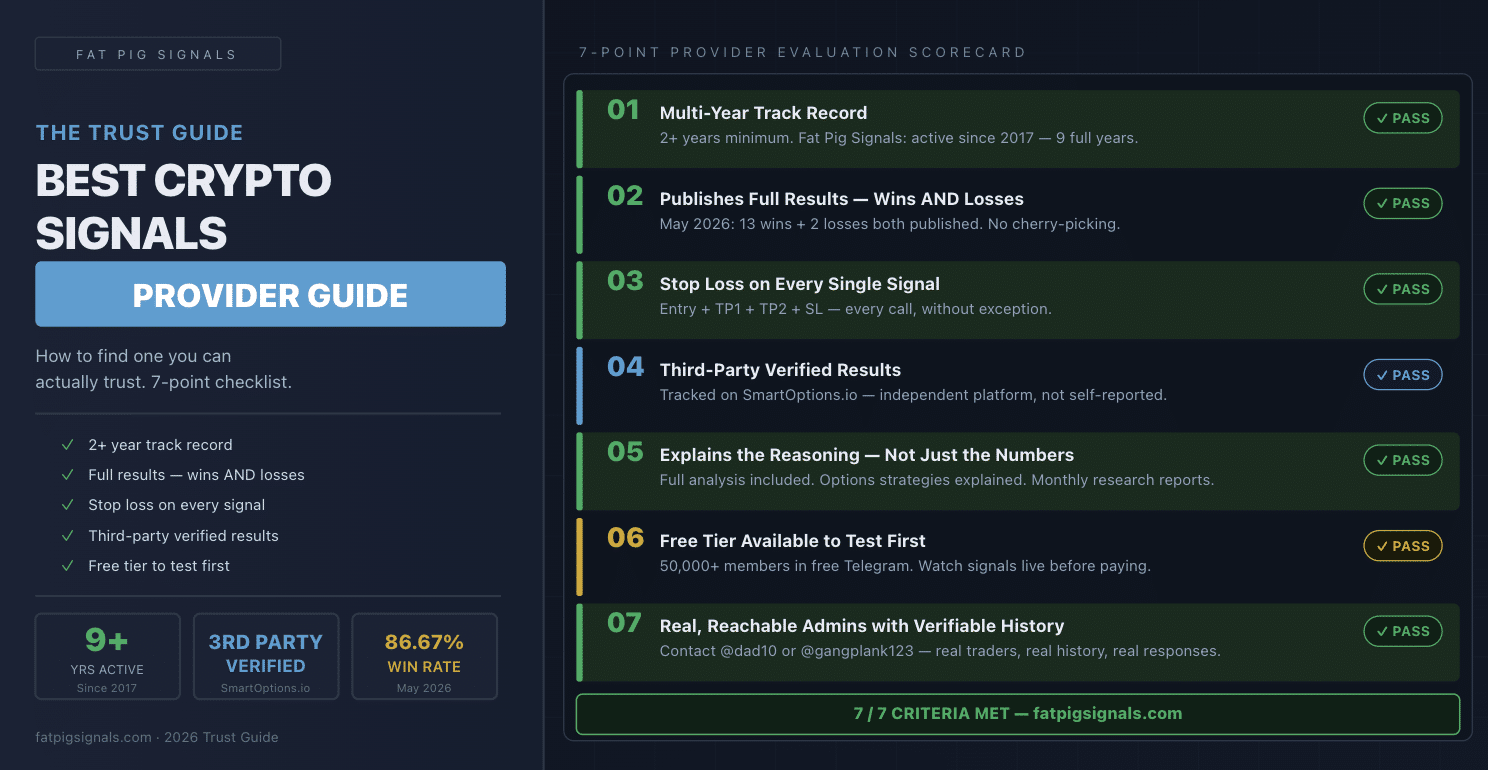
The 7-Point Checklist: How to Evaluate Any Signal Provider
1. How Long Have They Been Operating?
This is the first filter. A minimum of two years in operation is table stakes. Ideally, you want to see five years or more — because that means they've operated through at least one full Bitcoin cycle.
Bitcoin cycles typically run four years (bull run → crash → bear market → recovery). A provider who only has history from one phase of that cycle — say, the 2021 bull run — has never been truly tested.
What to look for: A clear founding date on their website or Telegram channel. Verifiable posts or activity going back multiple years. Any provider that can't show you when they started is a red flag.
Benchmark: Fat Pig Signals launched in 2017. That means their signals have been tested through: the 2017 ATH and 80% crash, the 2018–2019 bear market, the 2020 COVID crash, the 2021 ATH, the 2022 collapse after FTX, and the current cycle. Nine years across every market condition imaginable.
2. Do They Publish Full Results — Including Losses?
This is the single most important signal of legitimacy.
Any provider can post winning trade screenshots. Scammers do it constantly. What separates a real operation from a fake one is whether they publish the full picture — every trade, win or loss, with verifiable entry and exit data.
What to look for: A public results page, a pinned spreadsheet, or monthly breakdowns that include loss trades. Not cherry-picked highlights — everything.
What a healthy win rate actually looks like: Professional traders win roughly 55–70% of their trades. Anyone claiming 90%+ win rates across hundreds of trades is lying or cherry-picking.
Real data benchmark: Fat Pig Signals May 2026 — 13 winners, 2 losses (86.67% for the month). Previous months show a similar pattern: consistently profitable, never claiming perfection. The two losses in May were cut at pre-set stop losses before they could compound. That's what professional loss management looks like.
Pro Tip: If a provider has been operating for 2+ years but can't show you results from the 2022 bear market specifically — walk away. That was when most fake services disappeared. Real providers have the data.
3. Does Every Signal Include a Stop Loss?
Non-negotiable. Full stop.
A stop loss is the automatic exit level that limits how much you can lose if a trade goes against you. It's the most basic element of professional risk management.
If a signal provider sends you an entry price without a stop loss, they are not managing your risk. They're just pointing at prices and hoping. That's not analysis — that's gambling with your money.
What to look for: Every single signal should contain:
- Entry price (or entry zone)
- Take profit target(s) — ideally two or three levels
- Stop loss level
If any of those three are missing, the signal is incomplete.
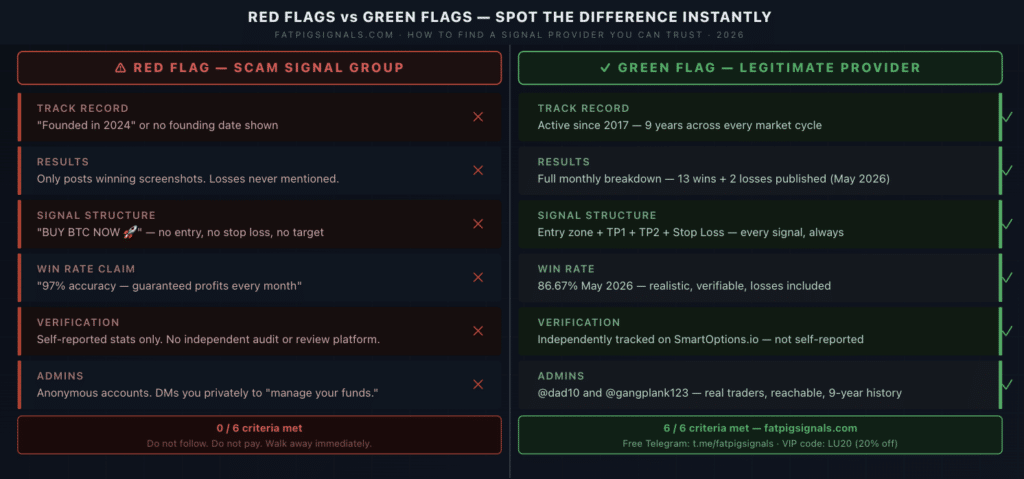
Red flag: Signals that say "buy BTC now 🚀" with no structure. This is noise, not analysis. It's posted after the fact when a move is obvious, or it's designed to create FOMO.
4. Is There Independent Third-Party Verification?
Anyone can edit a spreadsheet. Anyone can screenshot a fake trade. The question is whether the results are independently verified by a third party who has no financial incentive to lie.
What to look for: Mentions on independent review platforms (Trustpilot, Reddit, specialised signal review sites). Third-party auditors or performance tracking services. Reviews from real users that include specific trade details, not generic praise.
What to avoid: Testimonials that only appear on the provider's own website or Telegram channel. Screenshots of "profits" with no verifiable trade data. Accounts that were clearly created to post positive reviews.
Fat Pig Signals is tracked on SmartOptions.io — an independent signal verification platform — which provides external verification of performance data that isn't controlled by the service itself.
5. Do They Explain Their Reasoning?
There's a fundamental difference between a signal service and a signal factory.
A signal factory pumps out entry/exit numbers with no context. You don't know why they're buying. You don't know what the thesis is. You're just blindly copying someone else's decisions.
A signal service explains the reasoning: what pattern they identified, what the market structure looks like, what would invalidate the thesis, and how much risk is appropriate for the setup. You're learning while you trade.
Over time, the second approach builds your own trading instincts. The first creates permanent dependency.
What to look for: Analysis included with signals. Chart annotations. Monthly or weekly research reports. Explanations of why a trade is being closed early, or why a stop loss level was placed where it was.
Real example: The May 2026 covered call on BTC-31JUL26-86000-C wasn't just posted as "sell this options contract." VIP members received a full explanation: why the strike was chosen at $86,000, what the premium capture strategy was, and — critically — why the position was closed after 8 days instead of waiting until the July expiry. That kind of transparency is what accelerates learning.
6. Is There a Free Tier to Test First?
Legitimate providers let you observe before you commit.
A free Telegram channel where you can watch signals being posted in real time — without paying — serves two purposes: it lets you verify the quality before spending money, and it demonstrates that the provider is confident enough in their work to show it publicly.
What to look for: An active free channel with real signals (not just motivational quotes and market commentary). Ideally, the free signals should be a representative sample of the paid tier, not a completely watered-down version designed to look impressive while delivering nothing.
What to avoid: Providers who have no free content at all, or whose free signals are obviously different from what they claim to provide in the paid tier.
7. Are the Admins Real and Reachable?
This one sounds obvious but it eliminates a huge number of scams immediately.
Can you contact the admins? Do they respond? Are their identities verifiable through other channels — a website with history, social media profiles that predate the last bull run, mentions in legitimate crypto media?
Red flags:
- Admins who only communicate via anonymous accounts with no history
- No website, or a website that was registered in the last 6 months
- Admins who DM you privately to offer "investment management" or "managed accounts" — this is almost always a scam
- No response to direct questions about methodology or track record
What Real Performance Data Looks Like
To give you a concrete benchmark, here's what legitimate multi-year performance looks like in practice.
Using Fat Pig Signals' May 2026 data as an example:
Swing Trades:
- HYPE: +26.32%
- Chinese Life: +14.53%
- APTOS: +9.34%
- ZCASH: +6.94%
- Bitcoin: Profitable
- 8 additional winners
- 2 losses, both cut at pre-set stop losses
Options Strategy:
- Covered call on BTC-31JUL26-86000-C
- Opened May 27th, closed June 4th — 8 days
- 83.70% of premium captured: $730.17 profit
- Closed early because remaining value didn't justify the risk of holding
What this tells you: A good month isn't about winning every trade. It's about winning more than you lose, letting winners run to target, cutting losers quickly, and occasionally executing a more sophisticated strategy (like options) when the setup is right.
That's the pattern you're looking for across multiple months — not perfection, but consistency.
The Two Questions to Ask Before You Spend Any Money
After reading all of the above, the decision framework is simple.
Question 1: Can this provider show me 2+ years of full results, including losing trades, across different market conditions?
If yes → proceed to evaluate further. If no → stop here. Don't spend money.
Question 2: Has this provider's free tier shown me signal quality I'd be willing to pay for?
If yes → consider the paid tier. If no → keep watching or look elsewhere.
Both questions have to be yes. One out of two isn't enough.
Quick Recap
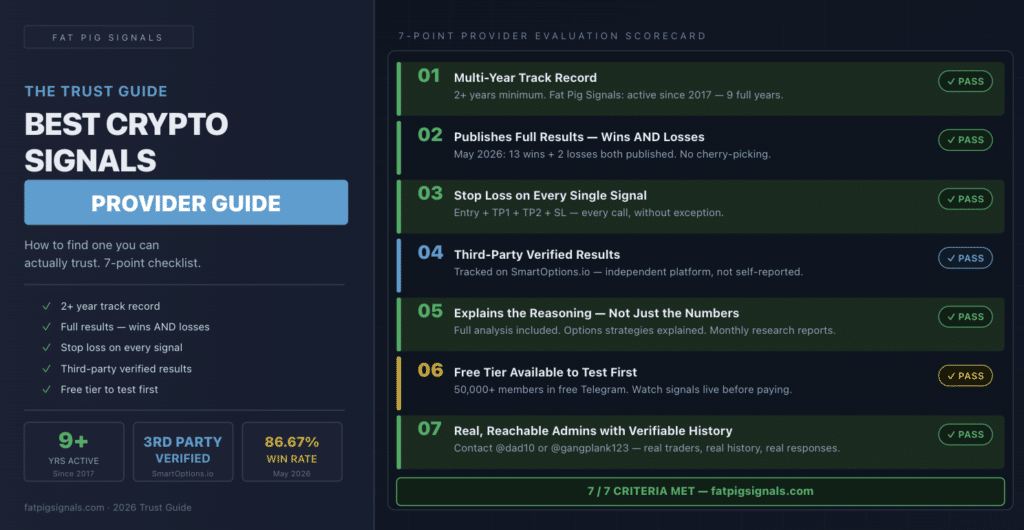
Here's the 7-point checklist distilled:
- Track record: Minimum 2 years, ideally 5+, across multiple market cycles
- Full results: Wins and losses both published, verifiable, not cherry-picked
- Stop loss always: Every signal — no exceptions
- Third-party verification: Independent platform or external reviews, not just in-house
- Reasoning included: Explains why, not just what — builds your own skills over time
- Free tier exists: Test before you pay. Real providers are confident enough to show their work
- Real admins: Identifiable, reachable, with verifiable history beyond the last bull run
Your Next Steps
Step 1 — Apply the checklist to anything you're currently following. Go through every signal group you're in right now and score them against these 7 points. Be honest. How many actually pass?
Step 2 — Join a free tier from a provider who passes the checklist. Watch the signals in real time for 4 weeks before spending any money. Count the wins. Count the losses. Check whether stop losses appear on every call.
Step 3 — When you're confident in the quality, consider the paid tier. The Fat Pig Signals free Telegram group is open now — you can watch how the research works before committing to anything. Nine years of public track record is there to verify.
Join the free Fat Pig Signals Telegram →
VIP members receive the full research — swing signals, options strategies, monthly performance reports, and market analysis — before the moves happen.
View Full Results → | Join VIP →
The right provider doesn't ask you to trust them blindly. They show you the work and let the track record speak.
That's what nine years of public results looks like.
Disclaimer: This article is for educational purposes only and should not be considered financial advice. Cryptocurrency trading involves substantial risk of loss. Past performance does not guarantee future results. Always conduct your own research before making trading decisions.
Related Articles

How to Set Stop Losses and Take Profit Targets

How to read altcoin trading signals