What Is Pyramiding in Crypto Trading? (How to Scale Into Winners the Right Way)
Trading
Most beginners think there are only two decisions in a trade: when to enter, and when to exit.
Professional traders know there's a third decision that matters just as much: when to add more to a position that's already working.
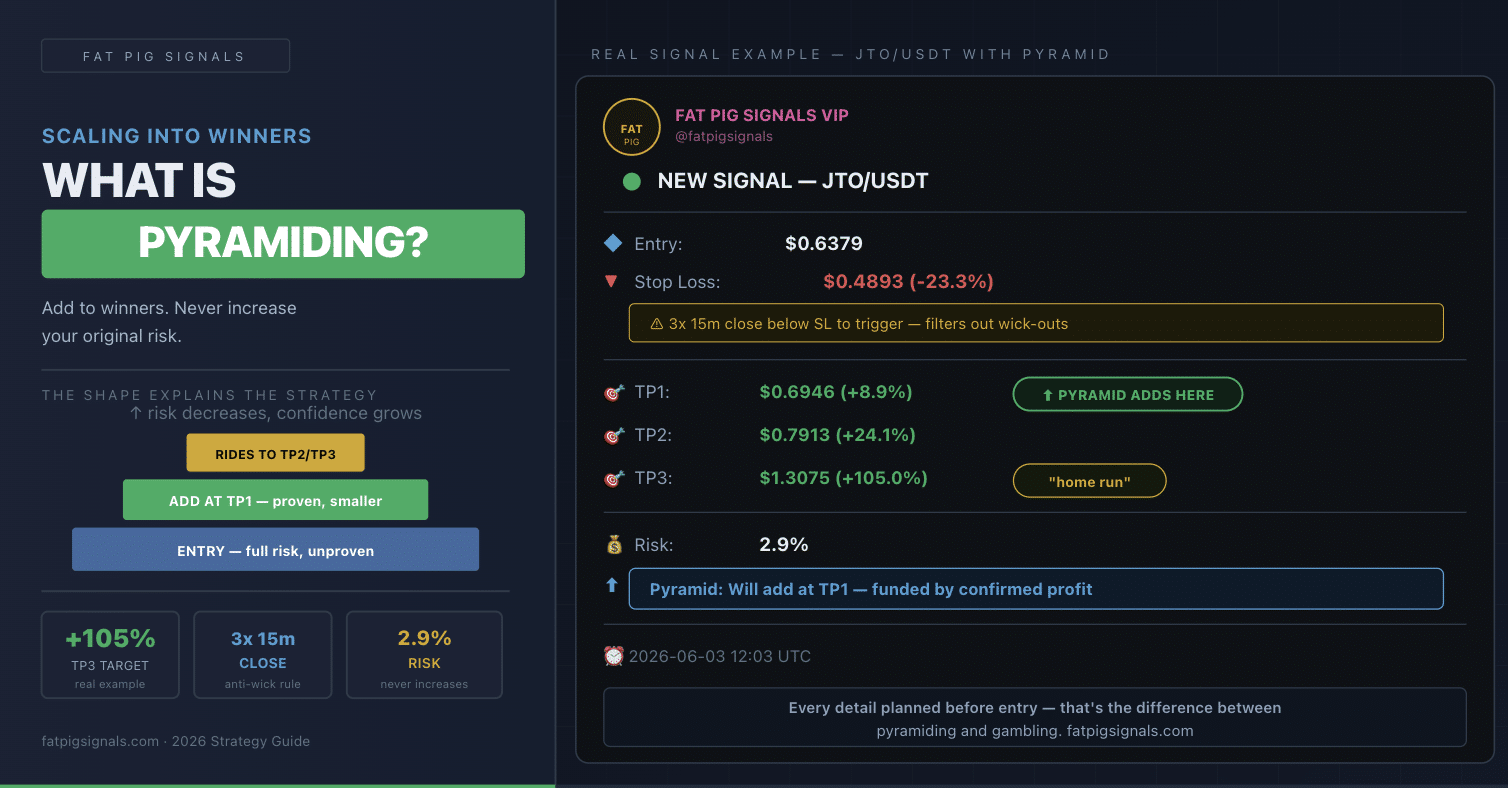
This is called pyramiding — and it's one of the most misunderstood concepts in trading. Done wrong, it turns a winning trade into a reckless gamble. Done right, it's one of the cleanest ways to scale your gains without increasing your original risk.
This article breaks down exactly what pyramiding is, why it works, and walks through a real signal — entry, stop loss, three take-profit targets, and a pyramid instruction — so you can see precisely how the pieces fit together.
What Is Pyramiding?
Pyramiding means adding to an existing position after it has already moved in your favour — rather than putting your entire position size in at once.
Picture a pyramid shape: a wide base at the bottom, narrowing as it goes up. That's exactly how the position sizing works. Your initial entry is the base — your first, largest commitment, placed when the trade idea is still unconfirmed. As the trade proves itself by hitting profit targets, you add smaller amounts on top — narrower layers, built only once the market has already validated your original idea.
This is the opposite of how most beginners instinctively trade. The common beginner mistake is to do the reverse: enter small, then "average up" aggressively or panic-add more when a trade starts working, chasing the move rather than scaling into strength with a plan.
Pro Tip: The name comes from the shape, not the risk. A pyramid is structurally stable because it's widest at the bottom. Position pyramiding works the same way — your biggest risk is taken at the start, while the market hasn't proven anything yet. Every addition after that is smaller and funded by money the trade itself has already made.
Why Pyramiding Works (When Done Correctly)
The core logic behind pyramiding comes down to one principle: add risk only after the market has reduced your uncertainty.
When you first enter a trade, you don't know if it will work. That's the highest-risk moment, which is why your initial position should be sized conservatively — using proper risk management, typically risking only 1-3% of your account.
Once the price moves in your favour and hits a take-profit target, two things have happened:
- The trade idea has been partially validated — the market is moving the direction you expected
- You've already locked in some profit, which can fund or offset the risk of the new addition
Adding to the position at this point isn't increasing your original risk — it's using money the trade has already generated to participate in more of the move, with a structure that's now safer than it was on entry.
This is fundamentally different from chasing a trade by adding more during a random pullback, hoping it bounces. Pyramiding only adds when the original plan has already proven correct.
A Real Signal, Broken Down Step by Step
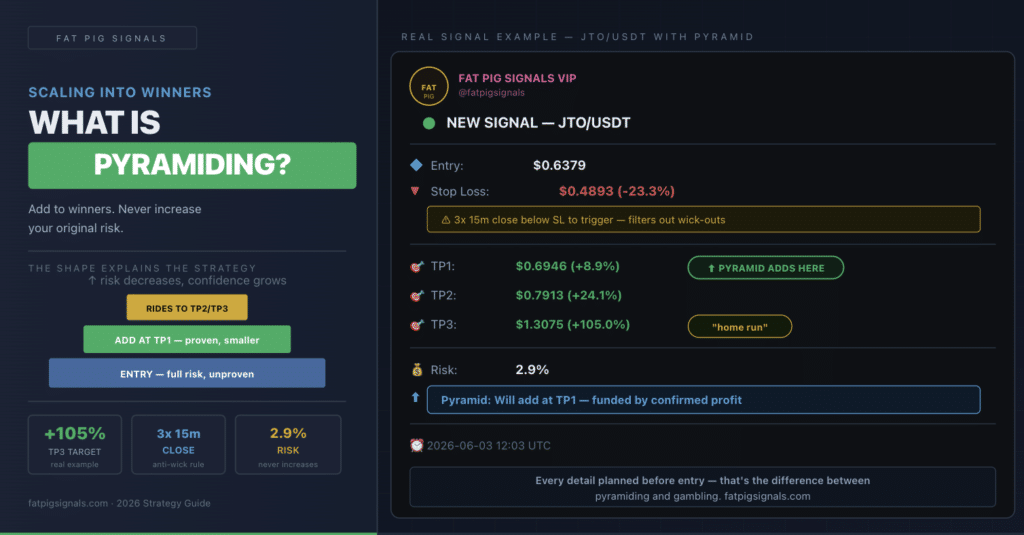
Theory is useful, but seeing the actual numbers makes this click. Here's a real signal structure, exactly as it would appear in a professional trading channel:
NEW SIGNAL — JTO/USDT
| Element | Value |
|---|---|
| Entry | $0.6379 |
| Stop Loss | $0.4893 (-23.3%) |
| Stop Loss confirmation | 3x 15m close below SL to trigger |
| TP1 | $0.6946 (+8.9%) |
| TP2 | $0.7913 (+24.1%) |
| TP3 | $1.3075 (+105.0%) |
| Risk | 2.9% |
| Pyramid | Will add at TP1 |
| Timestamp | 2026-06-03 12:03 UTC |
Let's walk through what every single line means — and why the pyramid instruction is placed exactly where it is.
Entry: $0.6379
This is the price at which the position opens. JTO is the token here, traded against USDT (a stablecoin pegged to the US dollar, used as the trading pair). At this stage, nothing has been proven yet — this is the base of the pyramid, the widest and riskiest layer.
Stop Loss: $0.4893 (-23.3%)
If the price drops to $0.4893, the trade idea is considered invalidated and the position closes to prevent further loss. Notice this isn't a tiny stop — it's placed at a meaningful technical level, 23.3% below entry, giving the trade room to breathe through normal volatility without being shaken out by noise.
"3x 15m close below SL to trigger"
This is a detail most beginner signals never include, and it solves a real problem: wick hunting.
A wick is the thin line on a candlestick showing the highest or lowest price briefly touched during a period — even if the price didn't close there. Exchanges sometimes see brief, sharp price spikes that touch a stop loss level for a few seconds before bouncing right back. If your stop loss triggers on any momentary touch, you can get stopped out of a perfectly good trade by noise that reverses seconds later.
The instruction "3x 15m close below SL to trigger" means: the stop loss only activates if three consecutive 15-minute candles close below $0.4893 — not just touch it. This requires sustained price weakness over at least 45 minutes, filtering out the kind of brief wicks that catch careless traders. It's a small detail that reflects a much more disciplined approach to risk management.
TP1, TP2, TP3 — Three Layers of Profit
Notice the targets aren't evenly spaced — they get progressively further apart:
- TP1 at +8.9% — close, achievable, first confirmation
- TP2 at +24.1% — a meaningful move, second confirmation
- TP3 at +105.0% — a major move, the "home run" scenario
This structure exists specifically to support pyramiding. Each target isn't just a place to take partial profit — it's a checkpoint where the trade has proven itself a little more.
Risk: 2.9%
This is the percentage of the account being risked on this specific trade if the stop loss is hit. It sits comfortably within the professional 1-3% range — sized to survive being wrong without doing serious account damage.
Pyramid: Will add at TP1
Here's the instruction that ties everything together. When the price hits $0.6946 (TP1, +8.9%), additional size gets added to the position.
Why TP1 specifically, and not entry, and not TP2?
Because TP1 is the first confirmation that the trade thesis is correct — close enough to entry that the setup hasn'd had time to fully play out, but far enough to prove the immediate direction. Adding here means the new layer is funded by a trade that's already working, riding the remaining move toward TP2 and TP3 with a position that's grown — without ever increasing the original 2.9% risk taken at entry.
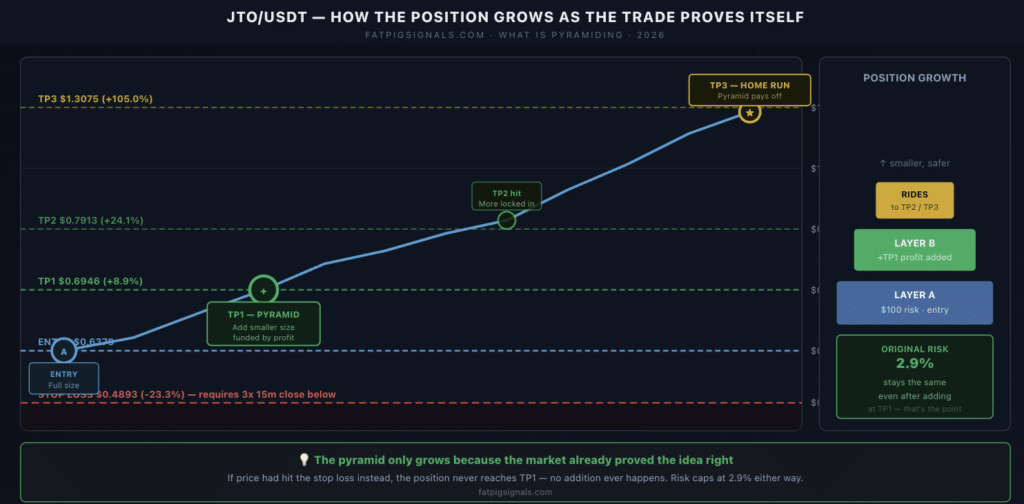
How the Pyramid Addition Actually Changes Your Position
Let's make this concrete with simple numbers.
Imagine you risk $100 (2.9% of a roughly $3,448 account) on the initial JTO entry at $0.6379.
When price hits TP1 at $0.6946, two things can happen depending on the exact strategy:
- A portion of the original position can be closed, locking in the +8.9% gain as realised profit
- New size gets added at the current price ($0.6946), funded partially or fully by that locked-in profit
The position is now larger heading into TP2 and TP3 — but the money funding that extra size came from the trade itself, not from increasing your original account risk. If the trade reverses from here, you're protected by profit already banked at TP1, not by hoping the rest of the move continues.
This is the entire point. You get more exposure to the best-performing trades, while your worst-case outcome on any single trade idea stays capped at the original risk you accepted on entry.
Common Mistake: Confusing pyramiding with "averaging up" recklessly — adding the same size or larger at each level without any structure, turning a planned trade into an emotional chase. True pyramiding always adds progressively smaller amounts, funded by confirmed profit, with the addition point planned in advance — not decided in the moment because the trade "feels good."
When Pyramiding Makes Sense (And When It Doesn't)
Pyramiding works well when:
- The original trade has a clear, multi-target structure (like the three TPs above)
- Each addition point is planned before the trade is even entered — not improvised
- The position size added is smaller than the original entry, not equal or larger
- You have genuine multiple take-profit levels giving the trade room to extend
Pyramiding is a mistake when:
- You're adding to a losing position, hoping it turns around (this is averaging down, a completely different and far riskier concept)
- The addition size is bigger than your original risk tolerance allows
- There's no predetermined plan — you're just feeling confident in the moment
- The original position didn't have a stop loss in the first place (without that foundation, none of this risk math holds up)
The discipline is what separates pyramiding from gambling. Every addition has a predetermined trigger price, a predetermined size, and is funded by the trade's own performance — not by hope.
Quick Recap
Here's what we covered:
- Pyramiding means adding to a winning position after it's already moved in your favour — building progressively smaller layers on top of your original entry, like the shape it's named after.
- The logic: take your biggest risk when uncertainty is highest (entry), then add only once the market has already validated the idea.
- Real signal example: JTO/USDT entry $0.6379, stop loss $0.4893 with a 3x 15-minute close confirmation to avoid wick-outs, three TP levels at +8.9%/+24.1%/+105.0%, and a pyramid addition planned specifically at TP1.
- The wick-filter detail ("3x 15m close below SL") protects you from being stopped out by brief, meaningless price spikes.
- Pyramiding ≠ averaging up recklessly. True pyramiding is planned in advance, funded by confirmed profit, and always smaller than the original position.
- Never pyramid into a loser. That's averaging down — a completely different, far more dangerous strategy.
Your Next Steps
Today: Look back at any recent trades you've taken. Did you have a plan for adding to winners, or did you just hold one fixed size from entry to exit? Either is fine as a starting point — but now you know there's a third option.
This week: If you place a trade with multiple take-profit levels, write down in advance exactly where you would add size if the trade reaches your first target — before you enter, not after. This removes the emotional decision-making in the moment.
When you're ready: Watch how structured signals — like the JTO/USDT example above — build pyramid logic directly into the trade plan from the start. Every detail, including the 3x candle stop loss confirmation, exists to protect the position while it has room to grow.
The Fat Pig Signals VIP Telegram posts signals with this exact level of structure — entry, stop loss with anti-wick confirmation, multiple TP levels, and clear pyramid instructions when the setup supports it.
Join the free Fat Pig Signals Telegram →
Scaling into winners isn't about being greedy. It's about being disciplined enough to let your best ideas work harder for you — without ever risking more than you planned to from the very first candle.
Disclaimer: This article is for educational purposes only and does not constitute financial advice. Cryptocurrency trading involves substantial risk of loss. The signal example shown is for educational illustration and should not be interpreted as a current trade recommendation. Always conduct your own research and never trade with money you cannot afford to lose.
Related Articles

How to Use Moving Averages in Crypto Trading

The Power of a Trading Journal for Risk Management and Profits