
How to Build a Crypto Portfolio from Scratch (The Honest Beginner Guide 2026)
Investment
Most guides about building a crypto portfolio start with a list of coins.
Bitcoin. Ethereum. Maybe Solana. A few "high-potential" altcoins. A splash of DeFi. Sprinkle in a meme coin "for fun."
Then they hand you some allocation percentages — 40% BTC, 30% ETH, 20% altcoins, 10% speculation — and call it a diversified portfolio.
Here's the problem: that formula was written without looking at the actual market. And right now, in July 2026, the actual market is telling you something very specific that most of those guides are ignoring.
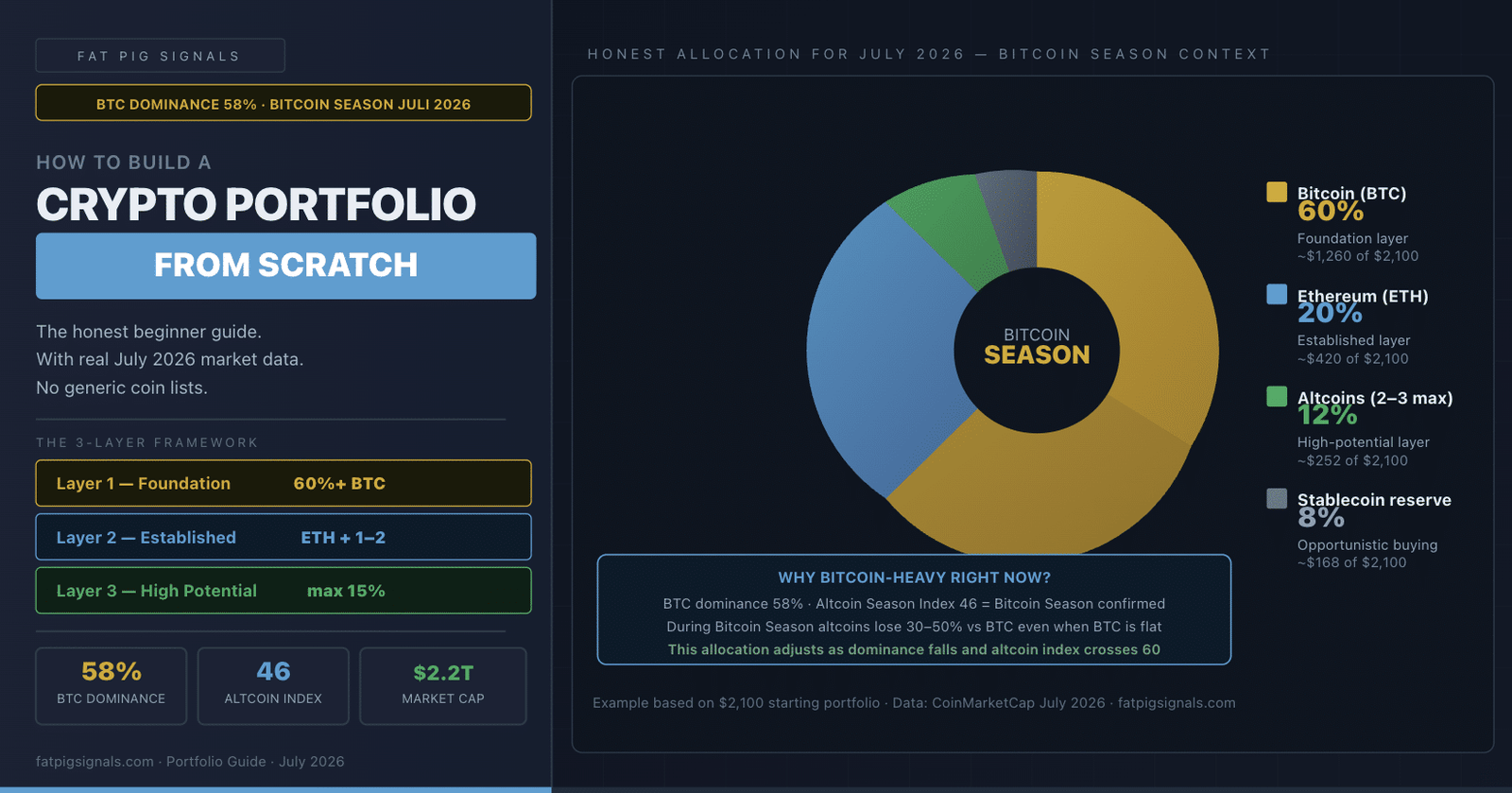
Bitcoin dominance is at 58%. The Altcoin Season Index sits at 46 — firmly in "Bitcoin Season" territory. Bitcoin continues to command over half of total crypto value, with the index showing no sustained shift toward altcoin leadership. Total market cap is stabilizing around $2.2 trillion after the correction from the October 2025 all-time high of $4.27 trillion.
This isn't a footnote. It's the single most important context for how you should build your portfolio right now.
This guide gives you the honest framework — not a generic coin list, but a thinking process you can apply to any market condition, starting with the one you're actually in.
Step 1: Understand What You're Actually Building (And Why)
Before picking a single asset, you need to answer one question: what is this portfolio for?
Not philosophically — practically. The answer determines everything else.
Option A — Long-term accumulation (12–36+ months) You believe crypto has a long-term trajectory upward. You want exposure without checking prices every hour. You're willing to hold through volatility. Your goal is to have more value in 12–36 months than you put in.
Option B — Active trading with a structured base You want to actively trade signals and opportunities, but you also want a stable long-term core that isn't touched by short-term decisions. Two separate pots — one for the long game, one for active positions.
Option C — Income generation on existing holdings You already hold BTC or ETH. You want to generate income from those holdings through options strategies without selling the underlying asset.
Most beginners don't know which they want because nobody asks them the question. They mix all three approaches in one account and end up with a confusing mess of positions, no clear strategy, and decisions driven by price alerts rather than a plan.
Pick one primary objective. The rest of this guide assumes Option A — the most common starting point for someone building from scratch.
The honest truth: Most beginners overestimate how much time they'll spend actively trading. Starting with a structured long-term core and adding active elements later is almost always the right order. The reverse — starting chaotic and trying to impose structure later — rarely works.
Step 2: Start With the Market Context, Not the Coin List
Here's what most portfolio guides skip entirely.
The right portfolio allocation changes depending on where you are in the market cycle. Building a portfolio in a euphoric bull market looks different from building one during a correction. And building in "Bitcoin Season" — which is exactly where we are now — looks different from building during altcoin season.
What Bitcoin Season means for your portfolio:
When uncertainty spikes — macro fears, regulatory crackdowns, a bear market — capital retreats to Bitcoin. It's the largest, most liquid crypto asset, and the one that institutions actually hold in size. During these phases, altcoins can lose 30–50% of their value against Bitcoin while Bitcoin itself might be flat or even rising.
Bitcoin dominance at 58% with the altcoin index at 46 tells you that capital is consolidating into Bitcoin. Altcoin rallies in this environment are selective rather than broad — driven by specific catalysts in individual projects, not a market-wide rotation.
What this means practically:
If you build a portfolio right now that's 30% Bitcoin and 70% altcoins, you are structurally betting against the current market dynamic. You might be right eventually. But the evidence says Bitcoin continues to command capital flows until the dominance index breaks down in a sustained way — and that hasn't happened yet.
The honest starting allocation for a beginner building in July 2026:
- 60%+ Bitcoin (BTC) — the anchor, the liquidity, the institutional favourite
- 15–20% Ethereum (ETH) — the second most established, the smart contract foundation
- 10–15% selected large-cap altcoins — only assets with genuine use cases and real liquidity
- 5–10% stablecoin reserve — not for yield, for opportunistic buying during dips
This isn't permanent. As market conditions shift — specifically, as Bitcoin dominance falls sustainably and the altcoin season index moves above 60 — you adjust the altcoin allocation. But you start Bitcoin-heavy because the market is Bitcoin-heavy.
The mistake most beginners make: They read a 2021 portfolio guide (written during altcoin season) and apply those allocations in 2026 (during Bitcoin season). The allocation that worked in one market phase is often the wrong one for the opposite phase.
Step 3: The Three Layers of a Solid Crypto Portfolio
Think of your portfolio as three layers, each with a different purpose.
Layer 1 — The Foundation (50–65% of total)
Bitcoin only.
Bitcoin is the foundation of every serious crypto portfolio because it's the most liquid, most established, most institutionally held, and — critically — the only crypto asset that has a verified track record of recovering from -80%+ drawdowns and reaching new all-time highs. Four times. <cite index="36-1">Bitcoin alone accounts for more than half of all crypto value — unsurprising given how many people own Bitcoin relative to any other single asset.</cite>
Beginners consistently underweight Bitcoin because it feels "boring" compared to smaller coins with more perceived upside. This is a mistake. The boring asset is the one that's been $10, $1,000, $10,000, $69,000, and $126,000. The exciting ones have usually gone to zero.
The FPS Portfolio Builder — the structured long-term accumulation strategy used by VIP members — anchors at exactly 60% Bitcoin for precisely this reason. Full explanation of that approach is in the DCA and Portfolio Builder guide.
Layer 2 — The Established Middle (20–25% of total)
Ethereum, and one or two other large-cap assets with genuine use cases.
Ethereum is the natural second position for most portfolios — not because it's guaranteed to outperform Bitcoin, but because it has the most developed developer ecosystem, the most total value locked in smart contracts, and the deepest institutional recognition after Bitcoin.
Beyond ETH, the criteria for Layer 2 assets should be strict:
- Top 20 by market cap
- At least 2 years of continuous operation
- Real, measurable usage (not just price speculation)
- Liquid enough to exit at any reasonable size without moving the market
In Bitcoin Season specifically, ETH is currently trading around $1,773 — relatively weak against Bitcoin. This is normal during periods of Bitcoin dominance. The position is held because over a full cycle, ETH has historically recovered and outperformed Bitcoin during altcoin season phases.
One or two assets here — not five, not eight. More assets in Layer 2 means more correlation, more monitoring, and often no better risk-adjusted returns.
Layer 3 — The High-Potential Exposure (10–15% of total)
Selected altcoins with specific, researched theses — and a strict size limit.
This is where most beginners put too much money and call it "diversification." Ten different altcoins at 10% each isn't diversification — it's ten correlated bets with ten times the monitoring requirement and, statistically, ten times the chance of a complete loss on at least one position.
Layer 3 should be 2–3 positions maximum. Each one should have a specific reason for being there — a protocol upgrade, an institutional adoption milestone, an ecosystem with measurable growth — not "I saw it on Twitter" or "it's been down 80% so it must bounce."
The hard rule: if you can't explain in two sentences why this specific asset, this size, right now — it doesn't belong in Layer 3.
Step 4: The One Rule That Determines Whether This Works
Everything above is asset allocation. Asset allocation is important. But the research is clear: most new investors make the mistake of investing all their money into a single cryptocurrency, but even when diversifying, the most common failure point is position sizing — risking more than the account can sustain through a drawdown.
The rule: never put money into any crypto portfolio that you cannot genuinely afford to leave untouched for 12–36 months.
This isn't a legal disclaimer. It's structural.
Crypto markets have multiple cycles every decade. The people who compound wealth through those cycles are the ones whose position sizes allowed them to hold through the corrections without being forced to sell. The people who lose money are frequently the ones who made the right long-term bet but with money they needed short-term — and were forced out at exactly the wrong moment.
Ask yourself honestly: if this portfolio dropped 50% tomorrow and stayed there for 18 months, would you be forced to sell? If the answer is yes, the position size is too large — not because 50% is guaranteed to happen, but because it has happened and knowing it's possible is the baseline you plan from.
The math on why this matters is in our guide on why most crypto traders lose money.
Step 5: How to Actually Build It (The DCA Entry Method)
Once you know your allocation, the question is how to enter.
Lump sum vs. DCA: Research consistently favors DCA — investing a fixed amount at regular intervals — over lump sum entries for new portfolio builders. Not because DCA always produces better returns on paper, but because it removes the paralysis of "is this the right time?" and the emotional devastation of investing everything at what turns out to be a local high.
With Bitcoin currently around $63,000 and the Fear & Greed Index near 27 (Fear), we're in a period where historical data suggests accumulation is more rational than waiting for "better conditions." Better conditions usually feel like higher prices and rising sentiment — which is exactly when you should be buying less, not more.
A practical DCA approach for a beginner starting with $5,000:
- Entry period: 12–16 weeks
- Weekly contribution: $300–$400
- Allocation per contribution: Follow your Layer 1/2/3 split every time
- Review: Every 30 days — not every price alert
The DCA Portfolio Builder guide explains the full mechanics, including the FPS approach of biweekly contributions into a maintained 13-asset Bitcoin-anchored basket.
The Three Portfolio Mistakes That Quietly Destroy Beginners
Before you touch a single purchase, know these:
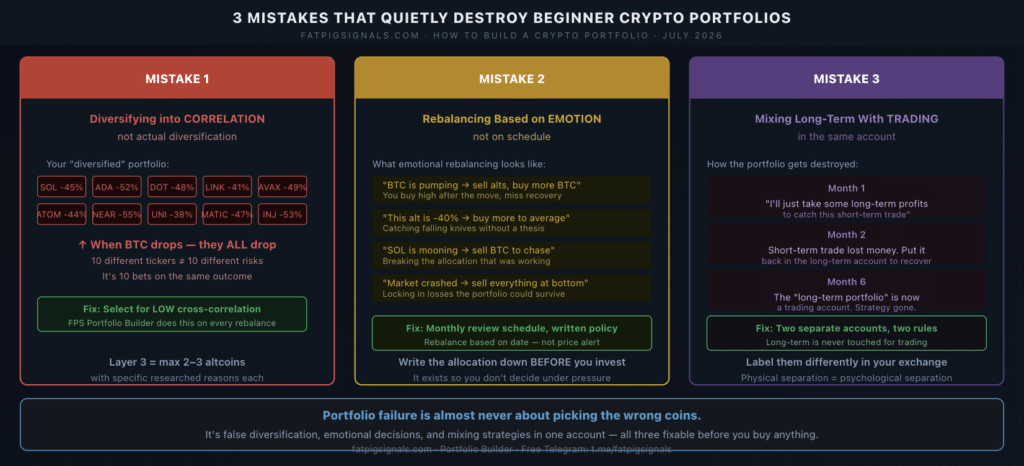
Mistake 1: Diversifying into correlation, not diversification. Holding 12 altcoins that all fall together when Bitcoin falls isn't a diversified portfolio. True diversification means assets with lower cross-correlation — which is why the FPS Portfolio Builder specifically selects for low cross-correlation between its 13 assets, not just different tickers.
Mistake 2: Rebalancing based on emotion, not schedule. "Bitcoin is going up so I'll sell my alts and buy more BTC" or "this altcoin is down 40%, I'll buy more to average down" — these are emotional rebalancing decisions, not systematic ones. Set a review schedule (monthly works for most beginners). Stick to it. Don't rebalance because price moved.
Mistake 3: Treating the portfolio as a trading account. Long-term accumulation and short-term trading are two different activities that require two different mindsets and two different accounts. The moment you start taking profits from your "long-term portfolio" to chase short-term trades, the long-term portfolio stops existing in any meaningful sense.
Quick Recap
- Start with your objective — long-term accumulation, active trading, or income generation. Don't mix all three in one account
- Read the market before building — Bitcoin dominance at 58% and altcoin index at 46 means Bitcoin-heavy allocation is the honest starting point for July 2026
- Three layers: Foundation (60%+ BTC) → Established middle (ETH + 1–2 large-cap) → High-potential exposure (2–3 researched altcoins, strict 10–15% cap)
- Only money you can leave for 12–36 months — forced selling at the wrong time is how portfolios fail, not bad coin selection
- DCA entry — fixed amount, fixed schedule, removes timing paralysis and emotional decisions
- Three mistakes to avoid: correlated diversification, emotional rebalancing, mixing long-term and active trading
Your Next Steps
Today: Calculate the exact amount you can genuinely commit for 12–36 months without needing it back. Not what you'd like to invest — what you can actually leave alone. That number is your starting point.
This week: Decide your Layer 1/2/3 split based on the current market context. Write it down. This is your policy document — it exists so you don't make decisions based on a price chart at 11pm.
When you're ready: The Fat Pig Signals free Telegram group posts market analysis alongside signals, giving you a live view of how professionals read current conditions — including what the current Bitcoin Season means for altcoin timing. That context is what you need alongside any portfolio framework.
Join the free Fat Pig Signals Telegram → See the full DCA Portfolio Builder strategy →
Building a crypto portfolio from scratch isn't complicated. What's complicated is building one that actually survives the corrections, the temptations, and the 18-month periods where nothing seems to be happening. The framework above handles all three.
Disclaimer: This article is for educational purposes only and does not constitute financial advice. Cryptocurrency investments involve substantial risk of loss. Market data cited reflects conditions as of July 2026 and changes continuously. Always conduct your own research and consult a qualified financial professional before investing.
Related Articles

Comparing Bitcoin Dominance and Altcoin Seasons

Best crypto alerts app: the wise choice