Why Fat Pig Signals Has No Face — And Why That's the Most Honest Thing About It
Telegram
Open any "how to spot a crypto scam" guide published in 2026 and you'll find the same list.
Guaranteed profits. Extreme urgency. Deleted losing trades. And near the top of almost every list:
"Anonymous admins — walk away immediately."
Anonymous admins with no verifiable platform, company, or track record behind them is one of the clearest red flags that expose scam groups.
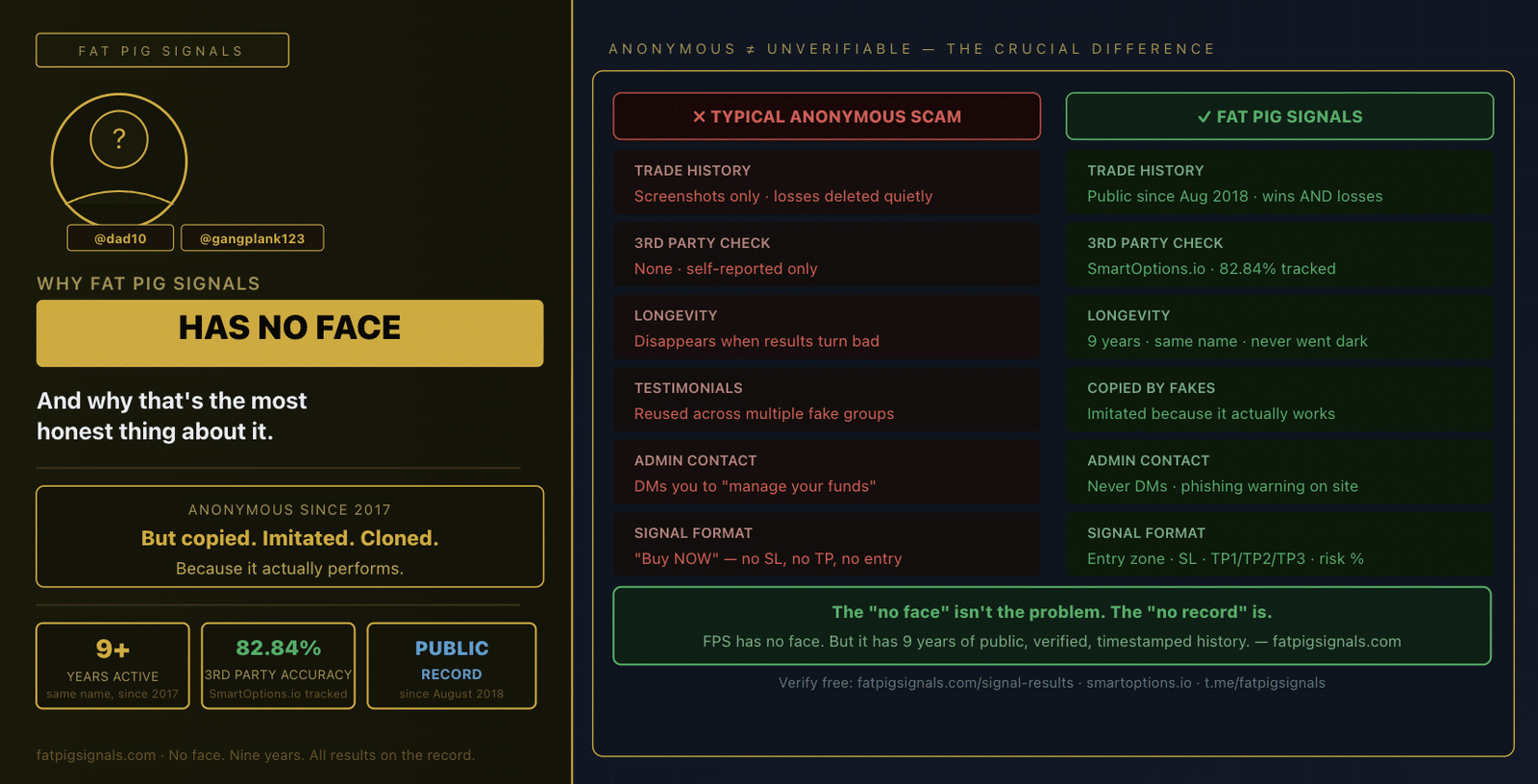
Fat Pig Signals has been operating since 2017. The admins — known only as @dad10 and @gangplank123 on Telegram — have no public face, no LinkedIn profile, no YouTube channel with a face cam, no conference appearances. They are, by every conventional definition of the term, anonymous.
And Fat Pig Signals is one of the most copied, cloned, and imitated signal services in crypto.
Not because it's a scam. Because it performs.
This article is about the tension between those two facts — and why the "anonymous admin" red flag, while generally correct, misses something important about what trust in this space actually means.
Why the "No Face" Rule Exists (And Why It's Usually Right)
The "anonymous admin" warning didn't come from nowhere. It exists because anonymity genuinely protects scammers in ways that transparency doesn't.
Anonymity plus zero verifiable track record plus high-pressure tactics is the formula. Check the timestamps. A legitimate signal posts before or at the entry price. If signals consistently appear in the feed minutes or hours after the move already happened, the provider is backdating them — calling trades retroactively to manufacture a win rate.
The scam formula is consistent: anonymous admin, no public history, screenshots of wins only, losses quietly deleted, pressure to join before "spots fill up." When you can't verify who is giving you advice — and there's no public, timestamped record of their calls — you have no way to evaluate whether they actually know what they're doing.
The credentials and experience of signal providers matter significantly. Groups led by traders with documented multi-year experience, professional certifications, or verifiable institutional backgrounds typically offer more reliable analysis than anonymous accounts. However, transparency about identity also creates accountability, as providers with public reputations have stronger incentives to maintain quality standards.
This is the correct logic. Identity creates accountability — if your name and face are attached to your calls, you can't disappear the moment results turn bad.
The rule is right. It's just not complete. Because it assumes that a face is the only form of accountability available. It isn't.
What Actually Creates Accountability in a Signal Service
There are two types of accountability in this space.
Type 1 — Identity accountability. A real name, a face, a verifiable professional history. You know who is giving you advice. If they disappear or perform badly, there's a person to point to.
Type 2 — Record accountability. A public, timestamped, independently verifiable history of every signal ever posted — wins and losses both — that anyone can audit at any time without paying anything.
Most influencers and "face-forward" signal providers offer Type 1. They are identifiable. They also frequently delete losing trades, post screenshots of winners only, and report accuracy rates that bear no resemblance to their third-party tracked results.
The gap between claimed win rates and third-party tracked rates is instructive — one major provider claims 92% but was tracked at 77.78% by SmartOptions in March 2026 across 22 trades. Still respectable, but far below marketing claims.
Fat Pig Signals offers Type 2. The admins have no face. But they have a public record going back to August 2018 — every single entry and exit, logged and timestamped — that you can verify right now, before spending anything, at fatpigsignals.com/signal-results.
And that record is independently tracked by SmartOptions.io — a third-party platform with no financial relationship to Fat Pig Signals — which has tracked 82.84% long-term accuracy and a 91.7% success rate in May 2025.
Ask yourself: which is easier to fake?
A face on a YouTube thumbnail — or a public, timestamped, independently verified trade record spanning nine years and five bear markets?
The Copying Problem: What Gets Imitated and Why
Fat Pig Signals gets copied. Regularly.
Fake groups appear on Telegram using the same name, similar profile pictures, and copied signal formatting. The phishing warning on the Fat Pig Signals homepage exists specifically because this has happened repeatedly enough to be a known issue. The real admins — @dad10 and @gangplank123 — never DM users to offer investment services or request money. If someone claiming to be Fat Pig Signals contacts you directly to offer managed trading, it's a scam.
Scammers can broadcast messages to thousands instantly. Fraudsters create copycat groups with nearly identical names. Always join through official website links, not Telegram search.
Here's the thing about getting copied: nobody counterfeits something worthless.
The fake Fat Pig Signals groups exist because the real one has a reputation worth stealing. You don't see people cloning anonymous Telegram channels that underperform — you see people cloning the ones where actual performance has created name recognition and community trust.
The imitation isn't evidence of a problem. It's evidence of something working well enough to be worth impersonating.
What 9 Years Without a Face Actually Tells You
Here is the real case for why the anonymous structure of Fat Pig Signals is not a weakness.
A scammer's anonymity is a feature for them. It lets them disappear. Launch a new group next month under a different name. Take your subscription money and vanish when results deteriorate.
Fat Pig Signals has operated under the same brand, the same Telegram handle, the same website, with the same public signal record — since 2017.
Nine years. Under the same name. With every result publicly logged.
That's not how scams work. Scams need mobility. They need to be able to move when the heat comes. A service that has been building a permanent, irreversible public record for nine years is structurally incapable of the disappearing act that anonymity usually enables.
The admins have no face. But they have something more durable: a public ledger of every trade they've ever called, which anyone can examine, which an independent tracker monitors, and which spans five major Bitcoin crashes without the service going dark or the record being scrubbed.
Legitimate services acknowledge market uncertainty and never guarantee specific outcomes. A crypto signal is only as valuable as your execution — what separates quality from hype is a verifiable, public history of results.
That history exists. It's been there since 2018. It survived the 2022 FTX collapse when dozens of signal services disappeared overnight. It survived the 2018-2019 crypto winter when most of the competition folded. It's still here in 2026.
How to Verify This Yourself — In 10 Minutes
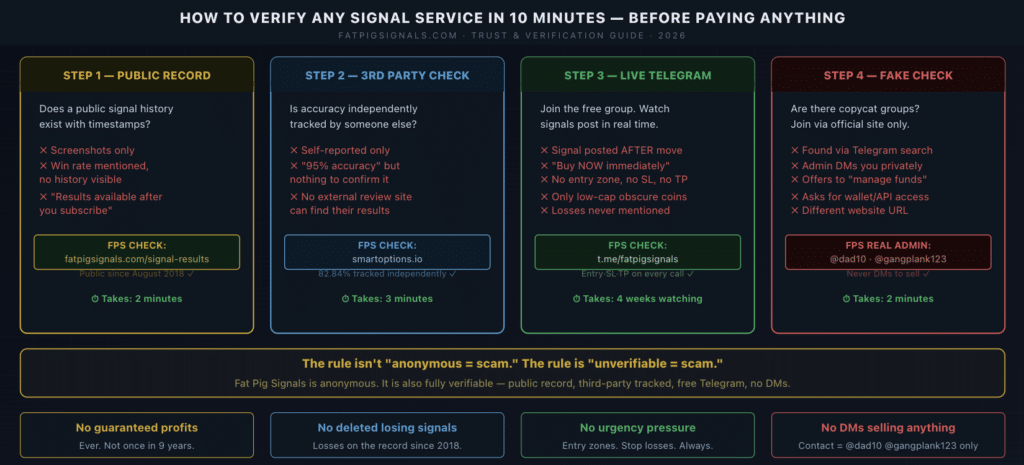
You shouldn't take this article's word for it. Here's exactly how to verify Fat Pig Signals' legitimacy before spending anything:
Step 1 — Check the public results page. Go to fatpigsignals.com/signal-results. You'll find the complete signal history. Look specifically at the losing trades — a provider who hides their losses is telling you something important about their honesty. Fat Pig Signals doesn't hide them.
Step 2 — Check SmartOptions.io independently. Visit SmartOptions.io and look up Fat Pig Signals. This is a third-party tracker with no commercial relationship to the service. Their numbers are what they tracked, not what FPS reported. 82.84% long-term accuracy, 91.7% in May 2025. Compare that to any other service you're considering.
Step 3 — Join the free Telegram group. Go to t.me/fatpigsignals. Watch the signals be posted in real time. Check the timestamps against price charts. Count wins and losses yourself over four weeks. This is what a verifiable signal service looks like in practice.
Step 4 — Search for the official source. The real Fat Pig Signals website is fatpigsignals.com. If you found a "Fat Pig Signals" group via Telegram search rather than through the official site, verify before joining — copycat groups exist and they prey on traders who don't check.
Reminder: Real Fat Pig Signals admins (@dad10, @gangplank123) never DM users to offer investment management, solicit funds, or request access to trading accounts. If anyone does this claiming to be FPS — it's a scam.
The Real Red Flags (That Most Traders Miss)
The "anonymous admin" rule is a proxy for the actual red flags. Here's what actually matters:
Screenshots prove nothing. Any image editor can flip a losing trade to a winner in under a minute. Legitimate providers maintain a public, timestamped trade history — either pinned in the Telegram group, linked from a website, or on a dedicated results page.
The real red flags are:
No public trade history. Not "anonymous admin" — no permanent, accessible record. If the only evidence of performance is screenshots, walk away.
Win rate claims with no third-party backing. A claimed 95% accuracy that no independent tracker has ever verified is meaningless. A tracked 82% is real.
Signals posted after the move. Check timestamps. If signals consistently appear after the entry price has already moved significantly, they're backdating.
Urgency and guaranteed returns. Legitimate signals have defined entry zones and stop losses. They don't demand you "buy NOW before it pumps." They don't guarantee you'll profit.
DMs offering account management. No real signal service manages your account for you via Telegram. If someone contacts you directly to "help you trade," they're stealing from you.
Fat Pig Signals has none of these. The admins have no face — but the service has a permanent, timestamped, independently verified track record that most face-forward influencers can't match.
Quick Recap
- The anonymous admin rule is mostly correct — anonymity protects scammers and most anonymous groups are not legitimate
- But anonymity isn't the real risk — unverifiability is. If you can't check the record, you can't evaluate the service, regardless of whether there's a face attached
- Fat Pig Signals is anonymous AND verifiable — public record since August 2018, independently tracked by SmartOptions.io, 82.84% long-term accuracy, 91.7% in May 2025
- Getting copied is a sign of performance, not a sign of problems — counterfeits only appear when the original is worth imitating
- Nine years under the same name with an irreversible public record is structurally different from anonymous groups that disappear — the record can't be scrubbed, the history can't be faked retroactively
- Verify yourself in 10 minutes — results page, SmartOptions.io, free Telegram group, all before spending anything
Your Next Steps
Start with verification, not with payment. Every claim in this article is checkable independently. The results page, the SmartOptions tracking, the free Telegram group — all publicly accessible. Start there.
Use the checklist from our guide to evaluating any signal provider. Apply it to Fat Pig Signals and every other service you consider. If a service can't pass a basic verification checklist, the admin's face won't protect you.
If you've been burned before, read our guide on how to spot fake crypto gurus — it covers the specific tactics used to fake performance and why the patterns are so consistent.
When you're ready to join: the free Telegram group is the entry point. Watch the calls. Check the timestamps. Verify the record. And if what you see matches what this article describes — then the VIP membership decision makes itself.
Join free Telegram → Check the full track record → Join VIP (code LU20) →
No face. Nine years. Every result on the record.
That's not a red flag. That's the answer to one.
Disclaimer: This article is for informational purposes only. Cryptocurrency trading involves substantial risk of loss. Performance data cited is from third-party sources and historical results do not guarantee future returns. Always conduct independent research before joining any signal service.
Related Articles
What Is Time Decay in Crypto Options? (And How to Get Paid by It)

Crypto signals telegram: how do they work to help you