
Top 10 Crypto Futures Trading Mistakes Beginners Make (And How to Avoid Every One)
Trading
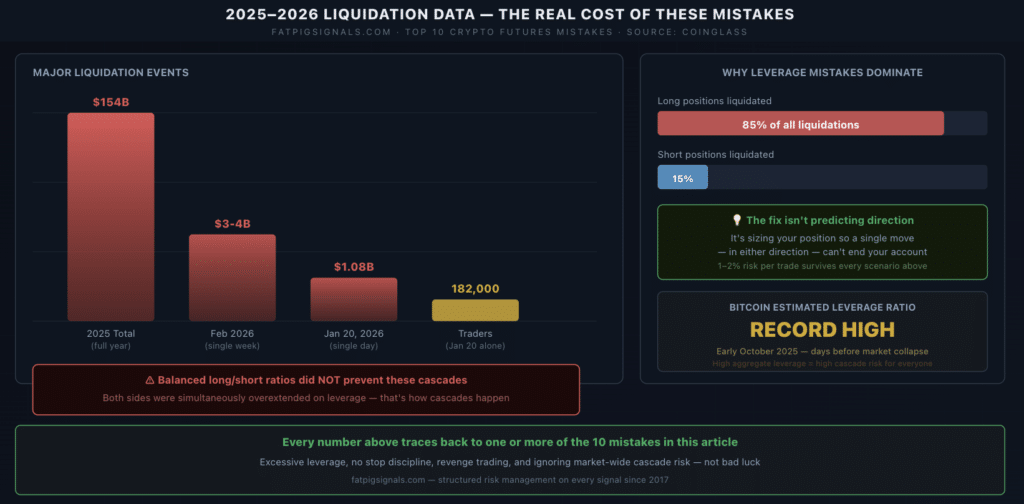
In 2025, more than $154 billion was wiped out in crypto futures liquidations. On a single day in January 2026, over 182,000 traders were forcibly closed out of their positions in 24 hours — more than $1 billion gone in a single session.
These weren't unlucky people. They made specific, repeatable, completely avoidable mistakes. The same ten mistakes, over and over, across every market cycle.
This article lays out exactly what those mistakes are — not vague warnings, but the specific habits that turn a manageable loss into a wiped account. If you're trading crypto futures, or thinking about starting, read this before you place another trade.
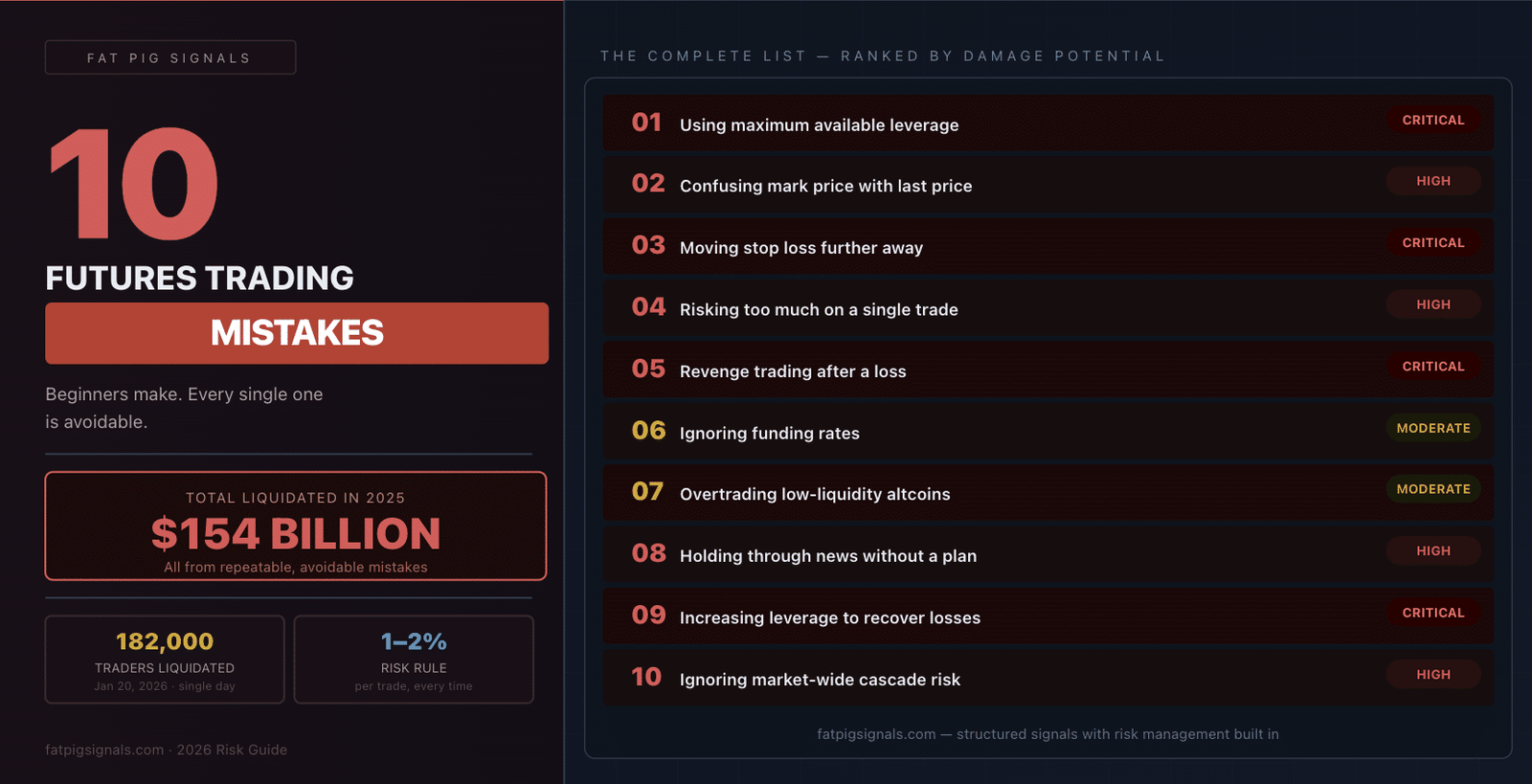
Mistake #1: Using Maximum Available Leverage
Exchanges offer leverage up to 100x, sometimes 125x. Beginners see that number and think it's a feature to use.
It isn't. At 100x leverage, a 1% price move against you triggers complete liquidation. Bitcoin moves more than that on an average Tuesday with zero news involved.
Professional traders consistently use 2x to 10x leverage for most positions, regardless of what the exchange allows. The available maximum and the sensible maximum are two completely different numbers — the gap between them is where most beginner accounts disappear.
The fix: Cap your leverage at 5x while you're learning. Increase it gradually only once you have a consistent track record over many months, not after one good week.
Mistake #2: Confusing Mark Price With Last Price
This is a technical detail that catches almost every beginner at least once.
Exchanges use two different price references: the last traded price (the most recent executed trade) and the mark price (a calculated fair-value reference used specifically to trigger liquidations). Your position gets liquidated based on the mark price — not the price you see flashing on the main chart.
During volatile moments, these two prices can briefly diverge. A trader watching the last price might think they have room before liquidation, while the mark price has already crossed their threshold. The liquidation happens anyway, often catching the trader completely by surprise.
The fix: Always check your exchange's specific liquidation price display — most platforms show this clearly before you confirm a trade. Never estimate it manually based on what the main chart shows.
Mistake #3: Moving Your Stop Loss Further Away
You set a stop loss when you opened the trade. The price approaches it. Instead of accepting the loss, you move the stop loss further down, giving the trade "more room to work."
This is one of the most destructive habits in trading, because it transforms a small, planned loss into a larger, unplanned one. The original stop loss represented the point where your trade idea was proven wrong. Moving it doesn't make the idea more correct — it just means you're now risking more money to find out you were wrong anyway.
The fix: Once a stop loss is set, treat it as fixed. If you genuinely believe new information justifies a different level, that's a decision to make calmly before the price gets close — never as a reaction while watching the trade move against you in real time.
Mistake #4: Risking Too Much on a Single Trade
Losing 20% or 30% of your account on one trade doesn't just hurt — it makes recovery mathematically brutal. A 30% loss requires a 43% gain just to get back to even. A 50% loss requires a 100% gain.
Professional risk management caps risk per trade at 1–2% of total account value. This isn't conservative for the sake of being cautious — it's the only approach that allows an account to survive a losing streak, which every trader experiences regardless of skill.
The fix: Before every trade, calculate exactly what 1–2% of your account equals in dollar terms. That number — not your gut feeling about the trade — determines your position size.
Mistake #5: Revenge Trading After a Loss
You lose a trade. Frustration kicks in. You immediately open a new position — often larger than the last one — specifically to "win back" what you just lost.
This is revenge trading, and it is statistically one of the worst-performing patterns in all of trading. The trade right after a loss tends to be the worst trade of the day, because it's driven by emotion rather than analysis. You're not evaluating a setup — you're trying to feel better.
The fix: Implement a mandatory cooling-off period after any loss — a minimum of 30 minutes away from the charts. If you hit your daily loss limit (a predetermined number, typically 2–3% of account value), stop trading entirely for the day. No exceptions, no matter how confident the next setup looks.
Mistake #6: Ignoring Funding Rates
Funding rates are periodic payments exchanged between long and short position holders on perpetual futures contracts, typically every 8 hours. They exist to keep the futures price anchored close to the actual spot price.
During strong trending markets, funding rates can spike significantly — sometimes reaching levels that cost a position over 2% in just a few days, entirely separate from price movement. A trader holding a multi-day position without checking funding rates can watch a technically correct trade lose money purely from this overlooked cost.
The fix: Before holding any leveraged position for more than a day, check the current funding rate on your exchange. If it's unusually high and working against your position, factor that ongoing cost into your decision to hold or close.
Mistake #7: Overtrading Low-Liquidity Altcoins
Major pairs like BTC and ETH have deep order books — large amounts of buy and sell orders waiting at every price level. Smaller altcoins often don't.
A modest position size that would barely register on Bitcoin can move a thin altcoin order book by several percent on its own. This means your own trade can work against you — pushing the price during entry, and again during exit, in a way that doesn't happen on liquid pairs.
The fix: As a beginner, stick primarily to BTC and ETH futures. If you do trade altcoins, check the order book depth first and size your position significantly smaller than you would on a major pair.
Mistake #8: Holding Through Major News Events Without a Plan
Crypto markets run continuously across Asian, European, and American trading sessions — there's always some economic release, regulatory announcement, or major development happening somewhere.
Holding a leveraged position through a known high-impact event (a central bank decision, a major regulatory announcement, a significant network upgrade) without a specific plan is a gamble, not a trade. Volatility during these windows can spike dramatically in either direction, and leveraged positions amplify that spike directly into your margin.
The fix: Know what's scheduled before you enter a position you intend to hold. If a major event falls within your expected holding period, either reduce your size, tighten your risk, or plan to close before the event — decided in advance, not during the volatility itself.
Mistake #9: Increasing Leverage to Win Back Losses Faster
This is a more dangerous cousin of revenge trading. Instead of simply re-entering after a loss, the trader increases their leverage — reasoning that a bigger multiplier will recover the loss more quickly.
The math works in exactly the opposite direction. Five consecutive 10% losses at 2x leverage still leaves roughly half your capital intact. A single 10% adverse move at 10x leverage liquidates the entire position outright. Increasing leverage after a loss doesn't speed up recovery — it dramatically increases the odds of total, immediate loss.
The fix: Leverage should never be a variable you adjust based on your emotional state or recent results. Set your standard leverage range when you're calm and rational, and treat any urge to increase it after a loss as a warning sign, not a strategy.
Mistake #10: Skipping Liquidity Cascades in Position Sizing
A liquidation cascade happens when a sharp price move forces leveraged positions to close, and those forced closures push the price further in the same direction — triggering even more liquidations in a feedback loop.
This isn't a rare event. The January 2026 cascade liquidated over 182,000 traders in a single day. A February 2026 deleveraging event wiped out $3–4 billion in a single week, with Bitcoin futures open interest dropping more than 20% in days. When a large number of traders are positioned the same way with high leverage, even a moderate price move can trigger this kind of feedback loop — and balanced long/short ratios don't protect you, because both sides can be simultaneously overextended.
The fix: Pay attention to overall market leverage conditions, not just your own position. When funding rates are elevated and open interest is climbing rapidly, the market is more crowded with leveraged positions — which means cascade risk is higher, regardless of which direction you're trading.
Quick Recap
Here's the complete list, distilled:
- Using maximum leverage — the available maximum isn't the sensible maximum
- Confusing mark price with last price — liquidation triggers on mark price, always check it directly
- Moving your stop loss further away — turns a planned small loss into an unplanned large one
- Risking too much per trade — cap it at 1–2% of account value, every time
- Revenge trading after a loss — the trade right after a loss is statistically the worst trade of the day
- Ignoring funding rates — a hidden, recurring cost that can silently drain multi-day positions
- Overtrading thin altcoins — your own position size can move the price against you
- Holding through major news without a plan — know the calendar before you hold through it
- Increasing leverage to recover losses faster — accelerates total loss, not recovery
- Ignoring market-wide cascade risk — crowded leverage conditions raise risk for everyone, regardless of direction
Your Next Steps
Today: Pick the single mistake from this list that sounds most like something you've done — or are currently doing. Be honest. Most traders recognise at least two or three immediately.
This week: Write down your personal rules for leverage cap, risk per trade, and your cooling-off period after a loss. Having these decided in advance — before emotion is involved — is what actually makes them work.
When you're ready: Apply these rules alongside signals that already build proper risk management into the structure — entry, stop loss, and take-profit levels defined before the trade happens, not improvised during it.
The Fat Pig Signals free Telegram group posts signals with this exact structure, including stop loss placement based on technical levels rather than guesswork.
Join the free Fat Pig Signals Telegram →
The traders who survive long enough to get good at this aren't the ones who avoid every loss. They're the ones who made these ten mistakes early, recognised the pattern, and built rules strong enough to stop repeating them.
Disclaimer: This article is for educational purposes only and does not constitute financial advice. Cryptocurrency futures trading involves substantial risk of loss, including total loss of deposited margin. Always conduct your own research and never trade with money you cannot afford to lose.
Related Articles

How Traders Capitalize on Crypto Market Crashes and Liquidations

Cryptocurrency Derivatives 101: A Beginner's Guide on Crypto Futures, Crypto Options, and Perpetual Contracts