
Spot Trading vs Futures Trading

Cryptocurrencies, Trading
Why Are There Two Ways to Trade the Same Coin?
If you’ve ever opened a crypto exchange and seen Spot and Futures tabs, you probably wondered, “Which one am I supposed to use?” You’re not alone—this is one of the most confusing decisions for beginners.
Right now, with crypto markets moving fast and volatility popping up often, understanding the difference between spot trading and futures trading matters more than ever. Picking the wrong one for your experience level can turn a small mistake into a big loss.
By the end of this guide, you’ll know:
- What spot trading really is
- What futures trading means and why it’s riskier
- How each one works with real-number examples
- Which one makes sense for you as a beginner
Let’s break it down calmly—no pressure, no hype.
What Is Spot Trading?
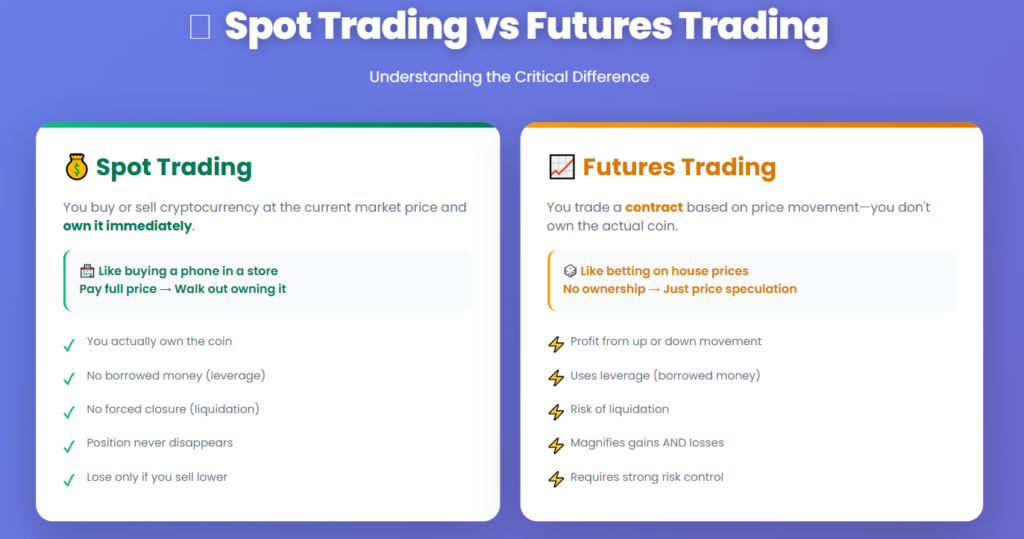
Spot trading means you buy or sell a cryptocurrency at the current market price and own it immediately. That’s the key idea: you actually own the coin.
Spot trading is like going to a store and buying a phone.
- You pay the full price
- You walk out owning it
- No contracts, no borrowed money
A Simple Spot Trading Example
Let’s say:
- Bitcoin price = $60,000
- You buy $600 worth of BTC
That means you now own 0.01 BTC. If Bitcoin goes up to $66,000, your 0.01 BTC is now worth $660. If it drops to $54,000, your BTC is worth $540.
Important: Your position does not disappear. There is no forced closure. You only lose money if you choose to sell lower.
That’s why spot trading is usually considered lower risk for beginners.
Why Spot Trading Is Popular With Beginners
Spot trading keeps things simple and predictable. Here’s why many new traders start here:
- No leverage (you’re not borrowing money)
- No liquidation (your trade won’t be auto-closed)
- You own the asset
- Easier to manage emotions
- Great for learning price behavior
Think of spot trading as learning to drive in an empty parking lot.
What Is Futures Trading?
Futures trading means you’re trading a contract, not the actual coin. A contract is an agreement to profit (or lose) based on price movement, without owning the asset itself.
In futures trading:
- You can profit if price goes up or down
- You can use leverage (borrowed money)
- You can be liquidated (forced out of a trade)
Let’s Define a Few Futures Terms (Simply)
Before going further, let’s clarify the terms beginners hear a lot:
- Leverage – borrowing money to control a bigger position
- Margin – the money you put up to open a leveraged trade
- Liquidation – when the exchange closes your trade because losses hit a limit
A Simple Futures Trading Example
Let’s say:
- Bitcoin price = $60,000
- You use 10× leverage
- You put in $600
With 10× leverage, you control a $6,000 position.
If price moves in your favor:
- BTC goes up 5%
- Your profit = $300
- That’s a 50% gain on your $600
If price moves against you:
- BTC drops 5%
- Your loss = $300
- If it drops further, you can be liquidated and lose most (or all) of your margin
This is why futures trading feels exciting—but dangerous.
Spot vs Futures: Ownership Is the Big Difference
Here’s the simplest comparison:
- Spot trading → You own the coin
- Futures trading → You own a contract
Think of It Like This
- Spot = buying a house
- Futures = betting on house prices
Both can make or lose money—but the risks are very different.
Spot Trading vs Futures Trading: Side-by-Side
Here’s a beginner-friendly comparison:
Spot Trading
- You buy and own the asset
- No leverage
- No liquidation
- Slower, steadier learning curve
- Best for beginners
Futures Trading
- You trade price movement only
- Uses leverage
- Can be liquidated
- Fast gains and fast losses
- Requires strong risk control
Why Futures Trading Exists at All
You might wonder, “If futures are riskier, why do people use them?” Good question.
Futures trading is useful for:
- Short-term trading
- Profiting in falling markets
- Hedging (protecting spot holdings)
- Advanced strategies
But here’s the key point: Futures trading is a tool—not a shortcut.
Used incorrectly, it can wipe out accounts very fast.
Common Beginner Mistake
Jumping into futures too early. Many beginners:
- See big profit screenshots
- Use high leverage
- Skip stop-losses
This often leads to fast losses and frustration.
Pro Tip: If you can’t manage risk in spot trading yet, futures will magnify every mistake.
Which One Should You Start With?
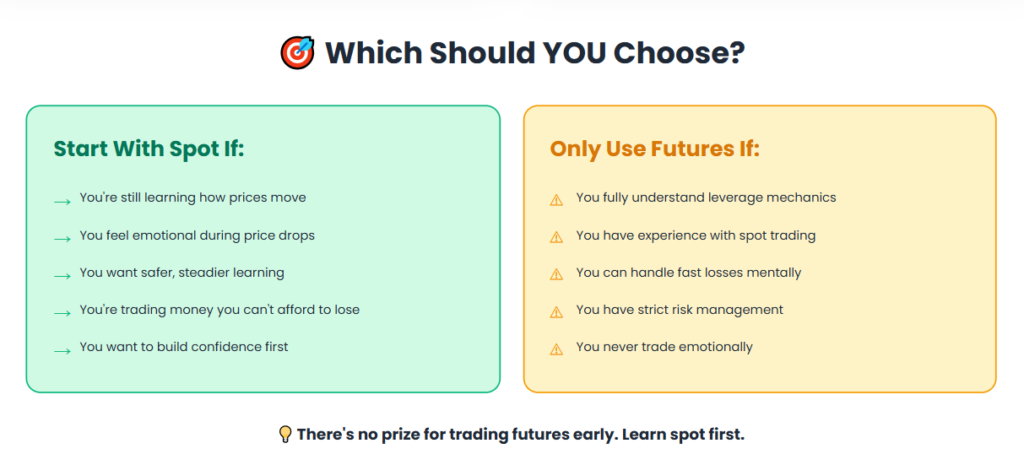
Ask yourself these questions:
- Are you still learning how price moves?
- Do you feel emotional during small price drops?
- Are you trading with money you can’t afford to lose?
If you answered “yes” to any of these → spot trading is the better starting point.
Many traders inside the Fat Pig Signals Telegram community begin with spot setups to understand market structure before even considering futures.
Step-by-Step: A Beginner-Friendly Path
Here’s a calm way to approach trading:
- Start with spot trading
- Learn entries, exits, and patience
- Practice risk management
- Observe futures trades without rushing in
- Only use futures when you fully understand leverage
There’s no prize for trading futures early.
Risk Reminder
Crypto trading involves risk.
- Spot trading can lose value
- Futures trading can lose money fast
- Leverage magnifies mistakes
Always:
- Start small
- Use stop-losses when appropriate
- Never trade money you can’t afford to lose
There are no guaranteed profits—only probabilities.
Quick Recap
Before we wrap up, lock these in:
- Spot trading = buying and owning crypto
- Futures trading = trading price movement
- Spot is simpler and safer for beginners
- Futures involve leverage and liquidation risk
- Learning comes before speed
If this feels clearer now, you’re on the right track.
Conclusion & Next Steps
Spot trading and futures trading serve different purposes. As a beginner, your goal isn’t to trade everything—it’s to build confidence and consistency.
Your next steps:
- Stick to spot trading while learning
- Observe how futures work without rushing in
- Learn risk management before leverage
If you want to see how experienced traders apply both spot and futures responsibly, joining the Fat Pig Signals Telegram community can help you learn through real examples—without pressure or hype.
Take it slow. Trade smart. You’re building a skill, not chasing luck.
Related Articles

How To Swing Trade Crypto Like a Pro

Bull vs Bear Crypto: What's the Difference and How to Handle Both?