
What Is a Bitcoin Covered Call? How to Earn Income From BTC You Already Hold
News
On June 16, 2026, BlackRock launched BITA — the iShares Bitcoin Premium Income ETF.
It's the first yield-generating Bitcoin ETF in history. BlackRock, the world's largest asset manager with over $11 trillion under management, built an entire financial product specifically to do one thing: sell covered calls on Bitcoin and collect premium income.
Think about that for a second.
While most retail traders are still guessing whether to buy, hold, or sell — the biggest institution on earth just created a product that generates income from Bitcoin regardless of which direction it moves. And they're charging investors 0.65% per year for the privilege.
Individual traders who understand covered calls have been doing this themselves — on their own BTC — for years. No management fee. No middleman. Just premium in, time decay working in their favour, and a strategy that earns money in sideways and falling markets as well as rising ones.
This guide explains exactly how it works, from zero.
What Is a Covered Call?
A covered call is a strategy for generating income from an asset you already own.
Here's the one-sentence version: you give someone else the right to buy your Bitcoin at an agreed price in the future, and they pay you cash right now for that right. You keep the cash no matter what happens.
Let's make that concrete.
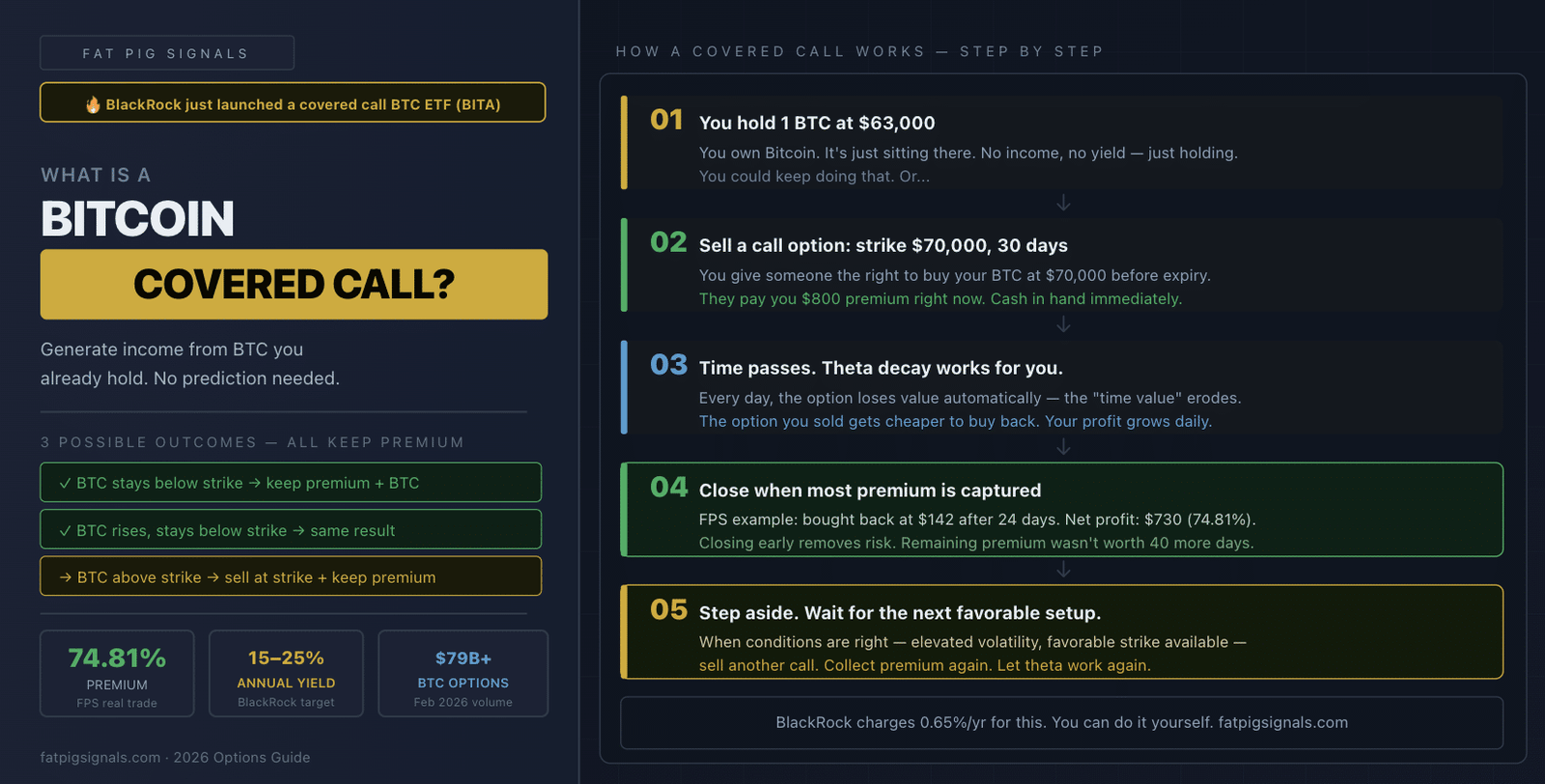
You hold 1 BTC, currently trading at $63,000. You sell a call option with a strike price (the agreed future sale price) of $70,000, expiring in 30 days. The buyer of that option pays you — say — $800 in premium today.
Now three things can happen:
Outcome 1: Bitcoin stays below $70,000 by expiry. The option expires worthless. The buyer never had a reason to use it. You keep your $800 and your full BTC position. The trade was profitable. Repeat next month.
Outcome 2: Bitcoin rises but stays below $70,000. Same result. Option expires. You keep premium and BTC. The fact that BTC went up is irrelevant — the option gave no value until $70,000, and it never got there.
Outcome 3: Bitcoin rises above $70,000. The buyer exercises their option, and you sell your BTC at $70,000 (the agreed strike). You keep the $800 premium plus the gain from $63,000 to $70,000 — but you miss any gains above $70,000. Your upside is capped.
In all three outcomes, you keep the $800 premium. The only question is whether you also keep the BTC.
The key insight: A covered call converts Bitcoin's volatility into immediate, predictable income. You're not hoping the price moves a certain way. You're selling the possibility of a big move — and collecting cash for it right now.
Why "Covered"?
The word "covered" matters. It means the call option you sold is backed by the actual BTC you own.
If Bitcoin does rise above your strike and the buyer exercises the option, you simply sell them your BTC at the agreed price. You're "covered" — you can deliver what you promised without any additional risk.
The alternative — a "naked" call, where you sell the right to buy BTC without actually owning it — is a completely different and far riskier strategy. If BTC rises sharply and you don't own it, you'd have to buy it at market price and sell at the (now lower) strike price. Covered calls carry none of that risk. Your maximum loss is the same as holding Bitcoin outright — the price could fall — but the premium you collected reduces that downside.
That's why covered calls are generally considered one of the most conservative options strategies. You're not speculating on price. You're monetising something you already own.
The Role of Time Decay — Your Silent Co-Worker
If you've read our guide on what time decay (theta) is in crypto options, this next part will click immediately.
Every option has a time value built into its premium — the portion of the price that reflects the possibility of Bitcoin moving significantly before expiry. As the days tick down toward expiration, that time value erodes. Every single day, automatically.
For covered call sellers, this erosion is your friend.
When you sold the covered call and collected $800, a portion of that $800 was time value. As each day passes without Bitcoin hitting your strike, that time value bleeds away. The option becomes cheaper and cheaper to buy back. Your profit grows — not because you did anything, but because time passed.
Covered calls can be understood as selling volatility rather than trading direction. Bitcoin options consistently price in the expectation of large swings, even during weeks when price action is relatively calm. That gap between what is expected and what typically happens is where call sellers get paid.
This is exactly why covered calls work particularly well in sideways or gently rising markets — the very conditions that frustrate most traders. While others are waiting for a big move, covered call sellers are collecting income from the waiting itself.
Real Numbers: What This Looks Like in Practice
Theory is useful. Real trade data is better.
Here's a recent example from Fat Pig Signals VIP — the exact covered call strategy in action:
Trade: BTC-31JUL26-86000-C
| Detail | Value |
|---|---|
| Contract | Bitcoin call option, $86,000 strike, July 31 expiry |
| Premium received | 0.0135 BTC → $1,011.12 |
| Position opened | May 27, 2026 |
| Position closed | June 4, 2026 (24 days later) |
| Buyback cost | 0.0022 BTC → $142.16 |
| Net profit | 0.0113 BTC → $730.17 |
| Premium captured | 74.81% in 24 days |
The position wasn't held to expiry. It was closed early — deliberately — because by day 24, the option's delta (a measure of how much it tracks Bitcoin's price) had fallen to around 0.04. The remaining premium was roughly $280, but capturing it would require holding for 40 more days with meaningful risk that Bitcoin spiked above $86,000.
The disciplined decision: lock in 74.81% of available profit, step aside, and wait for the next setup.
That's the covered call playbook in full: collect premium, let time decay do the work, close when most of the premium is captured, and repeat when the next setup becomes favorable.
Full results including this trade and all other options and signal performance are on the Fat Pig Signals results page. The complete May 2026 breakdown — 13 winning signals, 2 losses, plus the covered call — is covered in detail in the May 2026 results article.
How BlackRock's BITA Validates This Strategy
<cite index="44-1">BlackRock launched the iShares Bitcoin Premium Income ETF (BITA) on June 16, 2026 — an exchange-traded fund designed to provide investors with exposure to bitcoin while generating monthly option premium income.</cite>
<cite index="38-1">BITA targets 15–25% annual yield through a monthly options-writing program that encumbers 25–35% of the fund's net asset value, while retaining at least 70% participation in Bitcoin's price appreciation. BlackRock benefits from IBIT's robust options market, which provides BITA with tighter spreads and higher premiums than competitors.</cite>
This matters for individual traders because it provides a real-world institutional benchmark.
A fund managed by the world's largest asset manager, with institutional-grade risk management and options expertise, is targeting 15–25% annual yield through covered calls on Bitcoin. That's the range a sophisticated, disciplined covered call program aims for.
Individual traders executing their own covered calls — without a 0.65% management fee and without giving up control of their BTC — can access a similar strategy. The trade-off is that it requires judgment about when setups are favourable and the discipline to close positions early when risk-reward deteriorates.
Important context: BlackRock's BITA caps about 30% of its BTC upside to generate that yield. Any covered call strategy involves the same trade-off — you're exchanging some potential upside for guaranteed income now. In a violent bull market where Bitcoin doubles in a month, covered call sellers underperform simple holders. In sideways and falling markets, they outperform significantly.
Where to Trade Bitcoin Covered Calls
For individual traders wanting to execute covered calls directly, the primary platform is Deribit — the world's largest crypto options exchange, which processed over $79 billion in Bitcoin options in February 2026 alone and was acquired by Coinbase in August 2025 for $2.9 billion.
Deribit offers European-style Bitcoin and Ethereum options contracts, deep liquidity, and the tools needed to execute covered call strategies properly. Note that Deribit is not available to US residents — US-based traders can access Bitcoin options through Coinbase's regulated options platform or through regulated products like BITA directly.
For a full introduction to how options work on Deribit and the mechanics of strike selection and expiry timing, Coinbase's covered call explainer and Investopedia's covered call guide provide solid foundational reading alongside the practical examples in this article.
The most important thing to understand before executing any covered call: only sell calls against BTC you are genuinely comfortable potentially selling at the strike price. If Bitcoin rises above your strike and the option gets exercised, you're delivering BTC you own at the agreed price. The premium is yours regardless, but the BTC position changes. Size accordingly and choose strikes you'd be satisfied with as a sale price.
Covered Calls vs. Just Holding Bitcoin
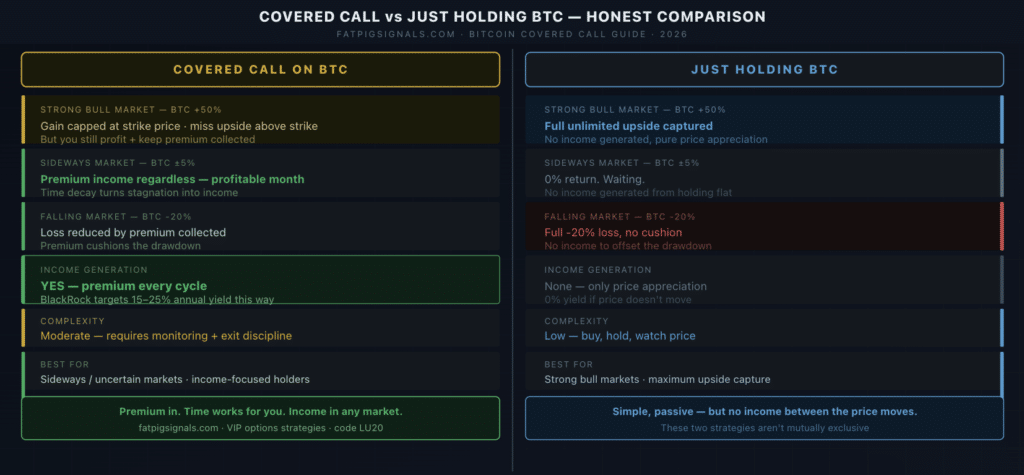
Here's the honest comparison most articles skip:
| Holding BTC | Covered Call on BTC | |
|---|---|---|
| Upside in bull market | Unlimited | Capped at strike price |
| Income generation | None | Premium each cycle |
| Sideways market | 0% return | Premium income regardless |
| Falling market | Full loss | Loss reduced by premium collected |
| Complexity | Low | Moderate |
| Time required | Passive | Active management required |
The covered call isn't "better" than holding outright — it's a different risk profile for a different objective. If you believe Bitcoin is going to 10x in the next year and you want full exposure to every percent of that move, selling covered calls will cap your gains.
If you want to generate income from your existing BTC holdings in sideways or uncertain markets, reduce the effective cost basis of your position, and earn regardless of short-term price direction — covered calls are one of the most efficient tools available.
That's why BlackRock built a product around it. And why experienced traders have been using it for years.
Quick Recap
Here's everything we covered:
- A covered call = you sell someone the right to buy your BTC at a higher price, collect premium now, keep it regardless of outcome
- "Covered" means you own the underlying BTC — zero additional risk beyond normal holding
- Three outcomes: BTC stays below strike (keep premium + BTC), BTC rises but stays below strike (same), BTC rises above strike (keep premium + sell BTC at strike, miss gains above)
- Time decay works for you as the seller — every day the option gets cheaper to buy back, automatically
- Real example: 74.81% of premium captured in 24 days on BTC-31JUL26-86000-C, closed early when remaining reward no longer justified the risk
- BlackRock validation: BITA launched June 16, 2026 targeting 15–25% annual yield through exactly this strategy — at institutional scale
- Best for: sideways or gently bullish markets, BTC holders who want income without selling their position
- Main trade-off: upside is capped at the strike price if Bitcoin runs hard
Your Next Steps
Today: Review the time decay guide if you haven't already. Understanding theta is the foundation for understanding why covered calls generate income automatically over time.
This week: Look at the current Bitcoin price and mentally select a strike price where you'd genuinely be comfortable selling your BTC. If Bitcoin is at $63,000, would you be happy selling at $70,000? At $75,000? Your answer tells you a lot about your risk tolerance and the kind of covered call structure that makes sense for your situation.
When you're ready: Fat Pig Signals VIP includes BTC and ETH options strategies — including structured covered call setups with clear entry rationale, strike selection logic, and early-close signals. Not just "sell a call," but exactly which contract, why, and when to close. It's the same methodology behind the trade above.
Join the free Fat Pig Signals Telegram → See full options and signal track record → Access VIP membership
BlackRock charges 0.65% per year for a fund that sells covered calls on Bitcoin. You could learn to do it yourself — with your own BTC, on your own terms, keeping 100% of the premium.
That's exactly what the VIP options program teaches.
Disclaimer: This article is for educational purposes only and does not constitute financial advice. Options trading involves risk of loss. Covered calls carry the risk of selling your underlying asset below its potential future market value if Bitcoin rises above the strike price. Past performance does not guarantee future results. Always conduct your own research and consult a qualified financial professional before trading options.
Related Articles

Troubled Hedge Fund 3AC Files for Bankruptcy Protection

PwC Account Hacked to Promote XRP Scam